


How OEM Buyers Can Reduce Rework Risk When Customizing 4-Way Locking Connector Power Splitter Cords
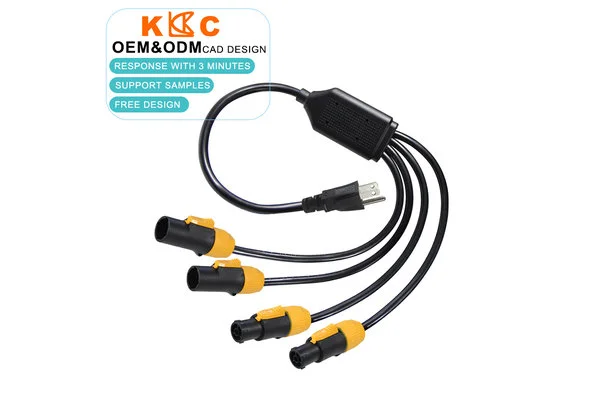
For buyers of stage lighting systems, AV equipment, exhibition setups, and rental devices, a power splitter cord may look like a simple accessory. In practice, it can affect the efficiency of the entire project. In OEM customization, unclear connector specifications, wire gauge, current load, or cable length may lead to sample mismatch, installation failure, heat-related complaints, or batch rework. Dongguan Kuncan Electronics Co., Ltd. provides NEMA 5-15P to 4-Way powerCON-Style Locking Connector Power Splitter Cords for multi-device power distribution applications where early specification confirmation matters.
Why Connector Compatibility Comes First in OEM Customization
In stage lighting and AV equipment applications, the value of a powerCON-style locking connector is not only that it connects power. Its locking structure also helps reduce accidental unplugging and loose connection risks in active installation environments. However, different devices may require different connector genders, input/output directions, pin configurations, and housing structures.
If these details are not confirmed before sampling, the result may be a connector that does not fit the equipment, a locking direction that does not match the installation layout, or a batch of cables that needs to be reworked. For OEM buyers, this increases communication cost, extends development time, and may delay project delivery.
When customizing a NEMA 5-15P to 4-way power splitter cord, buyers should first confirm connector type, gender, pin configuration, and the equipment-side interface. The 4-way powerCON-style locking connector output design is suitable for centralized power distribution to multiple compatible devices, especially in grouped lighting fixtures, exhibition booth wiring, and modular AV system deployment.
Why 14AWG/16AWG Wire Gauge Affects Heat Rise and Voltage Drop
The load of a 4-way power splitter cord is not carried by four separate input cables. It is supplied through one NEMA 5-15P input plug. Therefore, wire gauge selection directly affects heat rise and voltage stability during continuous operation.
NEMA 5-15P is commonly associated with North American 125V / 15A applications. For short cable lengths and light-to-medium loads, 16AWG may be a common choice. For longer lengths, multiple devices operating at the same time, or continuous-load environments, 14AWG is often worth evaluating. An undersized wire gauge may cause cable heating, voltage drop at the device end, unstable equipment operation, and eventually after-sales complaints or inspection risks.
This is why B2B buyers should not choose power splitter cords only by appearance or price. A more reliable approach is to calculate the total load first, then confirm the wire gauge according to cable length, operating time, installation environment, and certification requirements. For OEM projects, the choice between 14AWG and 16AWG should be clarified during the sample stage, not after end users report heat-related issues.
Branch Structure and Strain Relief Shape Long-Term Use
In rental, touring, and temporary event environments, cables are frequently coiled, transported, pulled, and plugged in repeatedly. For a multi-way splitter cord, the areas under the most mechanical stress are usually the branch point and connector tail, not only the plug itself.
If the split structure lacks proper strain relief, long-term use may lead to jacket cracking, conductor fatigue, or unstable contact. For rental companies and installation contractors, these issues can increase maintenance frequency, spare cable demand, and on-site troubleshooting cost.
A professional 4-way locking connector power splitter cord should therefore consider the stability of the molded split or junction-style branch, while selecting SJT、SJTW、PVC 或 rubber jacket according to the actual environment. A black cable jacket is commonly preferred in stage and AV applications because it blends more naturally into equipment backgrounds and reduces visual distraction.
Compliance and Custom Details Reduce Batch Procurement Risk
Different target markets may have different expectations for certification, labeling, and testing. North American buyers may pay attention to UL、cUL 或 ETL options, while European or other markets may involve CE、RoHS, or additional documentation. The final requirement depends on the cable structure, sales region, and application.
For OEM buyers, it is better to provide key information at the quotation stage: target market, rated voltage and current, cable length, wire gauge, connector model, gender, jacket material, color, labeling, packaging, and testing requirements. The clearer the specification, the easier it is for the supplier to develop a workable sample and reduce later rework.
The value of Dongguan (Shenzhen) Kuncan Electronics Co., Ltd. is not only in supplying a NEMA 5-15P to 4-Way powerCON-Style Locking Connector Power Splitter Cord. It also lies in helping buyers clarify connector compatibility, 14AWG/16AWG wire gauge selection, 125V/15A application conditions, and OEM customization details at the beginning of the project. For stage, AV, exhibition, and rental equipment applications that require stable multi-device power distribution, this early confirmation is often more valuable than correcting problems after production.


USER EVALUATE
Here is the customer's evaluation of us