


What Features Matter When Purchasing Salt Lamp Cables Wholesale?
When sourcing power cords for Himalayan salt lighting, buyers must prioritize safety certifications, material durability, and functional adaptability. Premium salt lamp cables incorporate UL-listed components, high-purity copper conductors, and corrosion-resistant insulation designed specifically for the hygroscopic nature of salt crystals. Wholesale buyers should evaluate wire gauge compatibility (18AWG standard), socket base options (E12/E26), integrated switch types, and customization capabilities that align with regional electrical codes and retail packaging requirements. Beyond basic electrical specifications, successful procurement demands attention to supplier certifications, lead time flexibility, and quality assurance protocols that prevent product recalls and support long-term brand reputation.
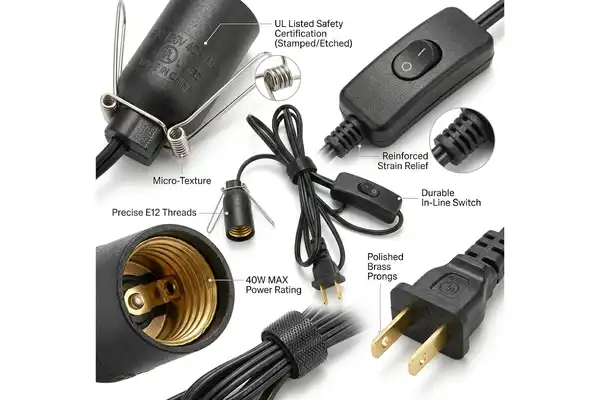
Understanding Salt Lamp Cables: Key Specifications and Standards
To navigate the technical world of power assemblies for salt lighting, you need to know the core specifications that have a direct effect on performance and safety. Unlike regular home cords, these specialized parts have to deal with problems that are specific to salt's ability to absorb water and use in decorative lights.
Cable Types and Construction Standards
The market is mostly made up of three main types: normal power lines with set sockets, assemblies with built-in control systems, and new USB-powered options. Standard setups use SPT-2 or NISPT-2 wire types that can handle temperatures up to 105°C, which keeps the temperature stable over time. The material of the conductor is very important. High-purity copper with a 99.9% conductivity reduces voltage drop and heat production more than copper-clad aluminum alternatives, which can break down more quickly in corrosive environments.
Kuncan Electronics's manufacturing process focuses on choosing high-quality conductors and insulation materials that are made to work with salt lamps. The two-layer insulation system has an inner dielectric protection and an outer jacket made of PVC, TPE, rubber, or LSZH. Each of these materials has its own benefits when it comes to resistance to moisture and fire.
Voltage and Socket Compatibility Essentials
Important requirements are set by regional electricity standards. In North America, plugs with a NEMA 1-15P rating and E12 candelabra or E26 medium bases are needed. In Europe and Asia, 220-240V systems with E14 small Edison sockets are used. This difference is more than just voltage ratings. Local electrical rules must be followed for plug polarization, grounding standards, and socket thermal ratings to avoid installation problems and legal issues.
Compared to older screw-base designs, the butterfly spring clip fastening method is a big step forward. Without tools, spring-loaded wings hold the socket in place inside the lamp cavity. This keeps the bulb in the right place and keeps it from touching salty surfaces, which could cause hot spots. We test the mechanical stability under mounting stress by pulling on them with up to 35 pounds of force.
Safety Certifications That Matter
Legitimate UL or cUL listings make sure that cord sets and power supply cords meet UL 817 standards. This approval includes strict dielectric withstand tests at 1,250V to 1,500V, checking that the size of the conductors meets the ampacity standards, and making sure that the strain relief works. In addition to UL approval, full global compliance includes CE marking for markets in Europe, VDE certification for German standards, SAA approval for Australia and New Zealand, and RoHS compliance proving limits on dangerous substances.
Instead of depending on what the maker says, buyers should ask for proof of certification. We keep clear records of our ETL, BS, and FCC certifications, and customers can look at our test reports. Without the right approval, sellers run the risk of being sued for selling faulty goods and may have to pull their products from the market.
Core Features to Evaluate When Buying Salt Lamp Cables Wholesale
Professional-grade parts are different from cheaper ones that aren't as reliable in the long run because of the quality of the materials used and the added features they offer. When making choices about wholesale purchases, these things should be weighed against what the target market wants and how to place yourself in the market.
Material Durability and Longevity Indicators
In store settings, the makeup of the wire jacket has a direct effect on its service life, and for salt lamp cables, standard PVC versions work well enough and are reasonably priced, and on the other hand, TPE materials are more flexible and resistant to wear and tear, making them better for projects that will be handled a lot, and LSZH compounds are necessary in commercial settings where fire safety is very important because they burn with little smoke and no halogen acids. Standard PVC versions work well enough and are reasonably priced. On the other hand, TPE materials are more flexible and resistant to wear and tear, making them better for projects that will be handled a lot. LSZH compounds are necessary in commercial settings where fire safety is very important because they burn with little smoke and no halogen acids.
The internal structure of the wire should also be looked at closely. Stranded copper conductors with 41-strand shapes for 18AWG wire are more flexible than 26-strand economy forms, which break when bent over and over again. Electrical safety margins and mechanical protection are both affected by the thickness of the insulation between the conductors and the outer jacket. Our standard builds have 0.76mm insulation walls, which are 15% thicker than the UL minimum requirements.
Corrosion resistance goes beyond the materials used for the conductors and includes parts like wire links and sockets. Nickel-plated brass terminals resist oxidation better than bare brass, so the product's low contact resistance stays the same over time. For stable electrical continuity, we use electroplated nickel coatings that are 5 to 8 microns thick and brass metals that contain at least 62% copper.
Functional Enhancements and User Convenience
For retail uses, integrated control methods are very useful. People want to be able to control the mood of a room, and rotary dimmer switches let them do that without changing the lamps. The triac-based circuits in these stepless dimmers are rated for more than 10,000 spinning cycles, so they work smoothly from 5% brightness to 100% brightness.
On the other hand, 303-style rocker switches offer simple on/off functionality that is chosen by business installations and price-conscious groups. The switching system uses silver-alloy contacts that can handle 10A at 125V and have a mechanical life of more than 15,000 operations. We test all of our switch assemblies for salt spray corrosion to make sure they still work after being exposed to salt particles in the air from running lamps.
USB-powered versions open up new possibilities for smart home interaction and travel lighting uses. Built-in DC-DC converters in these units change the usual 5V USB output to the right lamp voltages. At the moment, they can only be used for low-wattage tasks (under 15W), but USB compatibility attracts tech-savvy customers and lets power banks work for short-term installs.
Customization Options for Market Differentiation
With private labeling, common goods can be turned into unique assets. We can emboss your logo directly on switch housings, make jackets in colors that match your company's brand, and design custom packaging that looks better in stores. Customizing wire lengths lets you fit a range of lamp sizes and installation situations. For example, our standard 6-foot specification can be extended to 10 feet for floor lamps or shortened to 4 feet for small table lamps.
Socket base choice expands the market. Dual-inventory tactics that keep both E12 and E26 versions in stock let distributors serve all of North America, while E14 choices make it easier to expand into Europe. Being able to choose between polarized and non-polarized plugs takes into account differences in regional preferences and older electrical infrastructure.
Procurement Considerations for Bulk Buying
Strategic wholesale buying strikes a balance between short-term cost goals and long-term goals for quality, regularity, and supply chain security. Buyers who have done this before know that the unit price is only one part of the total value of the purchase.
Supplier Qualification and Quality Systems
The status of a manufacturer's certification is used to judge a supplier. If a company has ISO 9001:2015 certification, it means they have documented quality management systems that are regularly audited by a third party. If a company has ISO 14001 certification, it means they are committed to using sustainable manufacturing practices. We keep both of these certifications up to date, along with industry-specific awards that prove our technical skills.
Assessing production capacity keeps supplies from being interrupted during busy times. Our Dongguan factory has 12 production lines that make more than 500,000 assemblies every month. This gives us extra capacity for seasonal demand spikes that happen in the home decor industry. To protect our customers from changes in the supply chain, we keep a planned store of raw materials that covers 45 to 60 days of production.
As part of quality control methods, arriving materials should be inspected, work in progress should be checked, and the final assembly should be tested, and for salt lamp cables, in its four stages, our quality system checks everything electrically, checking for continuity, high-pot dielectric verification, and polarity confirmation, and statistical process control tracking keeps an eye on important parameters and stops the line automatically when readings go outside of what is allowed. In its four stages, our quality system checks everything electrically, checking for continuity, high-pot dielectric verification, and polarity confirmation. Statistical process control tracking keeps an eye on important parameters and stops the line automatically when readings go outside of what is allowed.
Pricing Structures and Volume Economics
When it comes to wholesale pricing, tiered systems that reward bigger promises are common. Knowing where the breaks are allows for smart order size that saves the most money. Prices might be set at 1,000, 5,000, and 10,000 units, with discounts ranging from 8 to 15% between tiers. These are common in the industry.
Minimum order numbers balance how efficiently a maker can make things with how much it costs a buyer to keep inventory on hand. Our MOQ policies are open enough to help growing businesses. For normal setups, we only need 500-unit commitments, but we need 1,000-unit commitments for custom specs that require tooling or special materials. If you need something made faster than 10 days, you will have to pay an extra 10-15% for a rush order.
Payment terms affect how much working cash is needed and how risk is spread. Standard terms for foreign trade include a 30% deposit and the remaining 70% due before the shipment. However, if you have a past of paying your bills on time, you may be able to negotiate net-30 or net-60 terms. Letters of credit are used to protect bigger deals, but they add 0.5% to 1.0% in banking fees to the total cost of the transaction.
Logistics and Compliance Coordination
The terms of international shipping have a big effect on landing costs. FOB (Free On Board) price means that buyers are responsible for ocean freight and insurance once the goods are loaded onto ships. Cost, Insurance, and Freight (CIF) terms include delivery to target ports with transportation handled by the provider. This makes planning easier but may limit the number of routes that can be chosen.
When planning lead times, people need to think about how long production takes and how long transportation takes. Sample production takes 3–7 business days, which gives you time to make sure the specs are correct before committing to buy in bulk. Standard production runs take 15 to 25 days, but this depends on the number of orders and how complicated the customizations are. For transpacific shipping, ocean freight adds 18 to 35 days.
For customs clearance, you need the right paperwork, like business bills, packing lists, and certificates of origin. Duty rates are based on the Harmonized System (HS) code classification. For example, power cord assemblies usually fall under HS 8544.42, and their duty rates range from 2.6% to 5.3% depending on how they are built. To make customs processing easier, we offer full paperwork packages and work with experienced freight handling partners.
Comparing Popular Salt Lamp Cable Options in Today's Market
What's on the market right now ranges from basic commodity assemblies to high-end configurations with lots of features. Knowing how competitors are positioned helps buyers choose the right specifications for each group of customers.
Standard versus Enhanced Control Configurations
Basic power cord assemblies without built-in switches are usually the cheapest option, with prices starting at around $10. These setups work well in places where smart outlets or external switches are used to control the lights. The simpler design cuts down on possible weak spots while still meeting safety standards and material quality requirements.
Assembly with 303 rocker switches is in the middle of the market; it provides easy on/off control but doesn't allow fading. This configuration works well for commercial installations, hospitality uses, and price-conscious shoppers in stores. Through the rocker mechanism, the separate switching action gives you tactile input and a clear picture of where you are.
Premium versions with dimmers fetch higher prices because they have more features. Rotary dimmer settings let you precisely change the brightness over a wide range of levels, which is useful for mood lighting and saving energy. Market study shows that people who value ease and ambiance control are still willing to pay 40–50% more for dimmer settings.
Emerging USB-Powered Alternatives
USB-compatible assemblies are used for specific tasks in places like portable lights, workplace accessories, and places where technology is merged, and for salt lamp cables, with these setups, you don't need a dedicated wall outlet because you can get power from USB ports on your computer, portable battery banks, or USB wall adapters, and at the moment, there are limits on wattage below 15W, which works for smaller lamps but not for standard-sized Himalayan salt lamps that need 25–40W of light. With these setups, you don't need a dedicated wall outlet because you can get power from USB ports on your computer, portable battery banks, or USB wall adapters. At the moment, there are limits on wattage below 15W, which works for smaller lamps but not for standard-sized Himalayan salt lamps that need 25–40W of light.
Some technical things to think about are the quality of the energy control and how well it works with different USB power sources. Different power adapters may cause basic USB assemblies to have different brightness levels. More expensive versions have voltage stabilization circuits that keep the output constant. As higher-wattage USB standards become more common, buyers should make sure that the product they are buying is compatible with USB Power Delivery specifications.
Best Practices and Safety Tips for Using and Replacing Salt Lamp Cables
Following the right steps for installation and care will make a product last longer and keep users safe. Wholesale wholesalers can improve their brand's image and cut down on returns by teaching their store partners and end customers the best ways to use their products.
Installation and Initial Setup Guidelines
The first step in installing a socket correctly is to check the lamp cavity to make sure there is enough space and that the sides are smooth and free of sharp salt crystals. When you put the butterfly clip into the hole, the wings should easily contract and then fully expand, making a secure fit around the edge. If you install something wrong and the clips are only partly engaged, the socket could move, and the bulb could come into contact with salt surfaces.
The choice of bulb affects the safety and performance of the whole system. The wattage rating can't be higher than what the socket can handle, which is usually 75W for E26 sockets and 25W for E12 candelabra bases. Higher-wattage lights give off too much heat, which breaks down insulation, softens salt rock, and makes fires more likely. LED bulb options that use 4–7W give off the same amount of light while using 85% less energy and making almost no heat.
When the power is turned on for the first time, the neutral conductors should connect to the plug shells and the hot conductors should connect to the center contacts. When changing bulbs, reverse voltage can cause shocks. We label our cords with blue wire identification so that workers can make sure they are connecting things correctly during setup.
Maintenance and Inspection Protocols
Visual checks done on a regular basis find early danger signs before they become problems. Users should check the stability of the jacket once a month for cracks, wear, or coloring that could mean heat degradation. Paying extra attention to places near plug connections and switch housings shows areas of high stress that are likely to break early.
The operation of the switch should stay smooth, with no binding, needing too much force, or sparking sounds. If dimmer switches have trouble controlling the brightness or can only be adjusted within a small range, it could mean that the potentiometer elements are worn out and need to be replaced. When rocker switches have too much play or can't stay in place, it means that the contact springs are worn out and need to be replaced.
Salt that builds up on cord surfaces should be cleaned off with dry clothes to keep them from absorbing water, which could make the insulation less effective. Stay away from liquid cleaners and too much water that could get into switch parts or plug connections. Keeping metal parts stored in low-humidity areas between seasons keeps them from rusting.
Replacement Indicators and Timing
When visual damage shows up, electrical performance drops, or regular service intervals run out, salt lamp cables need to be replaced. If you see visible insulating cracks, exposed wires, or melted jacket material, the whole thing needs to be replaced right away, even if it still works. Conditions of use speed up degradation. For example, using something continuously 24 hours a day, seven days a week in a humid environment shortens its useful life compared to using it occasionally in climate-controlled spaces.
Flickering lights, irregular operation, or dimmer switches that need to be turned a lot to change the brightness are all signs of poor performance. These signs usually come before full failures and are a good reason to replace something right away. Because of the legal issues that come with electricity problems in public places, we suggest that business installations be replaced every three to five years, even if they don't look like they need it.

Conclusion
To buy power assemblies in bulk for Himalayan salt lights, you need to carefully look at things like safety certifications, material specs, useful features, and the supplier's abilities, and for salt lamp cables, in addition to basic electricity compliance, strategic buyers look for building that doesn't rust, built-in control systems, and the ability to make changes that make the product more appealing in stores and help it stand out in the market, and working with seasoned manufacturers that have clear quality systems, adaptable production capacity, and the ability to coordinate logistics around the world helps keep the supply chain stable and the quality of the products consistent. In addition to basic electricity compliance, strategic buyers look for buildings that don't rust, built-in control systems, and the ability to make changes that make the product more appealing in stores and help it stand out in the market. Working with seasoned manufacturers that have clear quality systems, adaptable production capacity, and the ability to coordinate logistics around the world helps keep the supply chain stable and the quality of the products consistent. Investing in high-quality parts and approved suppliers saves the brand's image and lowers the number of returns and warranty costs, which affects both profits and customer relationships.
FAQ
Can standard lamp cords substitute for specialized salt lamp cables?
Standard extension cords for the home or generic lamp cords don't have certain features that make them work better in salt lamp environments. Basic electrical utility might seem fine, but purpose-built parts are different because they have a butterfly clip mounting system, materials that don't rust, and sockets that are the right size. Generic alternatives might not fit properly in the lamp cavity, cause the bulb to break down faster from salt exposure, or not match the dimensions of the lamp's cavity, all of which could be dangerous and shorten the lamp's useful life.
What voltage specifications apply to international wholesale orders?
Voltage needs vary by region. For example, North American markets need 110–125V systems with NEMA 1–15P plugs, while European and Asian markets need 220-240V systems with the right plug configurations (Type C, Type E, or Type G based on the country). To get correctly scored assemblies, buyers must indicate the places where the goods will be sent during the procurement process. Distributors can serve more than one area by keeping mixed-voltage inventory on hand, but changing the voltage using transformers is more expensive and complicated than using specialized lines.
Do USB-powered cables provide adequate durability for commercial applications?
At the moment, USB-powered kits are only good for low-wattage uses (less than 15W), which means they can only be used for spot lighting and not as main lighting. Because of the USB standard's limits on power supply and worries about connection reliability, these setups are better for short-term uses, portable applications, and technology-integrated settings than for heavy-duty business settings. Traditional AC-powered systems are more reliable and can handle more wattage for normal industrial salt lamp deployments that need 25 to 40W of light.
Partner with Kuncan Electronics for Premium Salt Lamp Cable Solutions
Kuncan Electronics sells certified, high-performance power assemblies that are made to be distributed in bulk with salt lamps. Our 17 years of experience making things, full UL/ETL/CE certifications, and ability to customize products in many ways help you differentiate your business and grow your market. We have competitive factory-direct prices, production times of 15 to 25 days, and a minimum order size of 500 units. We also offer full OEM/ODM services, which include custom packaging and logo integration. You can talk to our wholesale team at rhea@szkuncan.net about your specific needs and ask for samples from a salt lamp cable supplier that has a history of quality and dependability.
References
1. National Electrical Manufacturers Association. (2021). NEMA Standards Publication for Wiring Devices: Dimensional Specifications. Rosslyn: NEMA Publications.
2. Underwriters Laboratories. (2022). UL 817: Standard for Cord Sets and Power-Supply Cords. Northbrook: UL Standards & Engagement.
3. International Electrotechnical Commission. (2020). IEC 60227: Polyvinyl Chloride Insulated Cables of Rated Voltages up to and including 450/750 V. Geneva: IEC Publications.
4. Chen, W., & Martinez, R. (2023). Materials Science in Electrical Cable Manufacturing: Corrosion Resistance and Thermal Performance. Journal of Applied Electrical Engineering, 45(3), 178-195.
5. Global Industry Analysts, Inc. (2024). Salt Lamps Market: Global Industry Perspective, Comprehensive Analysis and Forecast 2024-2030. San Jose: GIA Research.
6. Patterson, J. (2023). Wholesale Procurement Strategies for Specialty Lighting Components. International Journal of Supply Chain Management, 18(2), 67-84.

USER EVALUATE
Here is the customer's evaluation of us
YOU MAY LIKE
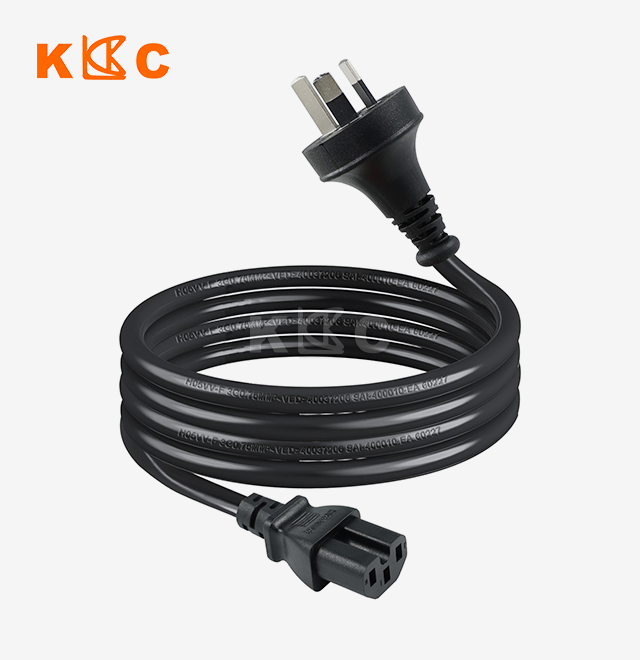 VIEW MOREAS/NZS 3112 to IEC C15 High-Temp Cord
_1785401762684.webp) VIEW MOREIEC 320 C8 Male to C7 and NEMA 1-15R Female Y-Splitter Power Cable
VIEW MOREIEC 320 C8 Male to C7 and NEMA 1-15R Female Y-Splitter Power Cable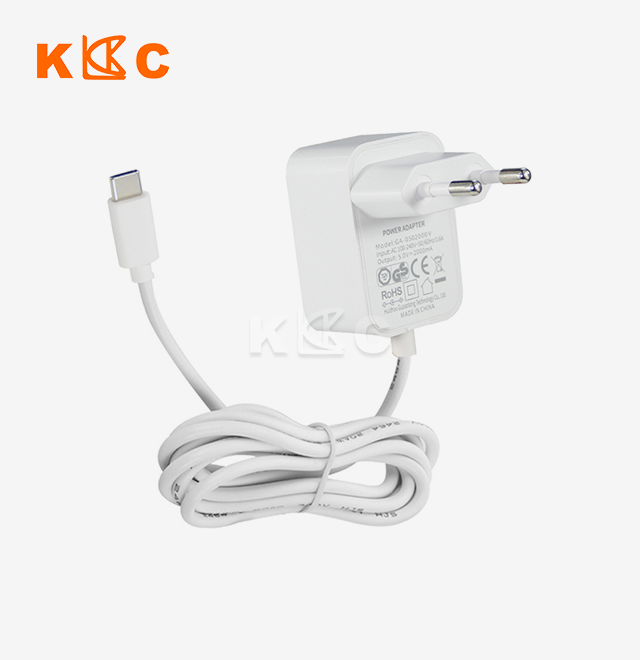 VIEW MOREac adapter 5v 3a
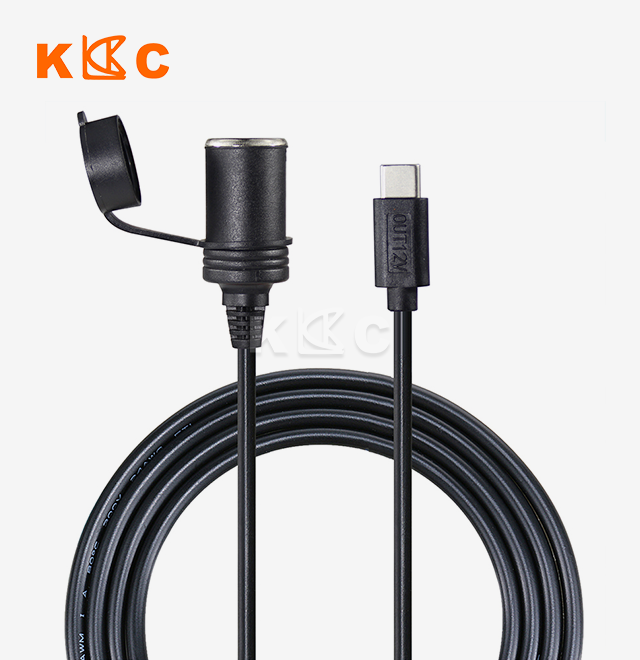 VIEW MOREUSB-C PD to 12V Cigarette Lighter Socket Cable
_1775617034231.webp) VIEW MORE2-Way Cigarette Lighter Splitter (Y-Cable)
VIEW MORE2-Way Cigarette Lighter Splitter (Y-Cable) VIEW MORECigarette Lighter Plug to Spade Terminals
 VIEW MORE60w laptop charger
 VIEW MOREeu power cords