


Improve Laptop Power Stability with a Reliable 3 Prong Laptop Power Cord Replacement
Upgrading to a dependable grounded power cable transforms how your enterprise equipment handles electrical loads. A reliable 3 Prong Laptop Power Cord stabilizes voltage delivery to laptop adapters, projectors, and docking stations, significantly reducing unexpected shutdowns and component stress. The grounding conductor dissipates fault currents safely, protecting sensitive circuitry from transient surges common in commercial buildings. For IT procurement teams managing fleets of business laptops, switching to industrial-grade NEMA 5-15P to IEC C5 cables minimizes warranty claims and extends hardware lifespan across demanding operational environments.
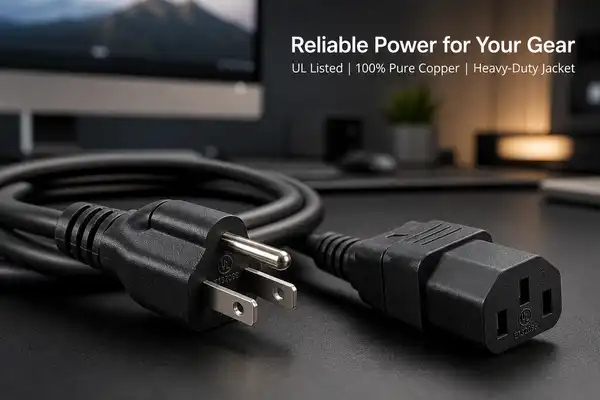
Understanding the 3 Prong Laptop Power Cord: Features and Benefits
Each grounded laptop cable that we make at Kuncan Electronics is carefully designed to meet the strict needs of B2B buyers who cannot afford failures in the field. The three-conductor design—live, neutral, and ground—is clearly better than two-prong designs, especially when equipment is used all the time in warehouses, offices, or field stations.
The Grounding Advantage: How the Third Prong Protects Your Investment
The grounding pin is directly connected to earth potential, which makes a fault current path with low resistance. When electrical problems happen, like a broken charger, a lightning-caused surge, or bad wiring, the ground wire moves extra energy away from the laptop's internals. This feature keeps the computer from getting damaged and data from being lost, safeguarding investments that usually cost more than a few thousand dollars each. Precision-molded strain-relief housings in our NEMA 5-15P to IEC C5 cables keep the ground connected even after thousands of plug cycles. This is important for equipment that moves every day between conference rooms and workstations.
Material Engineering: Why Conductor Quality Matters
Electrical stability starts with the make-up of the conductors. Every cable we make is made of high-conductivity 18AWG pure oxygen-free copper, which lowers resistive heating and voltage sag when the load is on it. Cheaper options that use copper-clad metal or less pure copper have higher resistance, which makes computers charge and discharge in unpredictable ways. We use a heavy-duty PVC jacket that meets UL 94 V-0 standards for flammability and is resistant to oils, wear, and water getting in. It is easy for procurement managers to see the difference when they put specs next to each other: better materials directly lead to fewer service calls and a lower total cost of ownership.
Compatibility Across Enterprise Ecosystems
In today's IT settings, laptops from different brands, like the Dell Latitude series, HP EliteBook models, and Lenovo ThinkPads, all connect to power sources outside the laptop. Our wires have an IEC 60320 C5 connection that works with all of these power bricks, so you don't have to keep a bunch of different types of cords on hand. The line can handle up to 10A at 125V AC, so it doesn't get too hot when doing jobs that use a lot of processing power. This standardization makes it easier to keep track of supplies and speeds up rollout when adding new employees or upgrading groups of equipment.
The same cable also powers small monitors at the front desk, portable projectors in training rooms, and network gear in server closets. Because of this, buying in bulk is a smart way to save money because it lowers the cost per unit while still ensuring consistent performance in a wide range of situations.
Comparing 3 Prong Laptop Power Cords to Other Power Solutions
To pick the best way to deliver power, you need to know how to balance safety, compatibility, and readiness for the future. Each type of link is good for a certain situation, but grounded AC cords are still the most common type used in business IT systems.
Grounded vs. Non-Grounded: Safety Standards in Practice
Because they don't have an earth connection, two-prong cords only use double insulation to keep you from getting shocked. This method is fine for low-power consumer devices, but it poses a risk in business situations where many devices share circuits and electrical noise builds up. The National Electrical Code says that when equipment with metal enclosures that are exposed is used above certain power levels, it must be connected to ground. Our 3 Prong Laptop Power Cords make sure that OSHA safety rules are followed, which protects site managers from harm.
AC Cords vs. USB-C Power Delivery: Matching Technology to Use Cases
USB-C Power Delivery makes it easy to charge ultraportable computers that use less than 100 watts of power. Because the system negotiates voltage on the fly, phones, tablets, and computers can all be charged with the same cable. But most enterprise-grade workstations, especially those with dedicated graphics or high-refresh displays, need power that lasts longer than USB-C can provide. When you pair our grounded lines with traditional AC plugs, you get stable 10A current that doesn't slow down due to heat. This keeps your computer running smoothly while you render in CAD, encode videos, or analyze data.
The fixed base is also important. Businesses that have bought hundreds of computers in the last five years mostly use barrel-plug adapters instead of USB-C ones. To retrofit this equipment, both adapters and cables would need to be replaced, which is a capital expense that most IT budgets can't cover. Grounded AC cords are a cheap way to make existing infrastructure last longer.
Quality Indicators: What Separates Industrial-Grade from Consumer Products
The prices on replacement laptop cords are very low if you go to any big-box store. These consumer-grade items have thinner wires (20AWG or less), lower-quality PVC that breaks when stored cold, and injection-molded connections that come loose after only a few uses. We tested samples from competitors in our lab, and many of them fail basic pull-force tests, showing the conductors after only 500 flex cycles.
Design validation tests are done on industrial-grade wires like ours. These include 5,000-cycle bend tests, high-pot insulation verification at 2,500V AC, and temperature rise readings at full rated load. We make our own plastic strain reliefs, which spread mechanical stress widely and stop wire fatigue that leads to links that don't stay together. Certifications like ETL and cUL aren't just for looks; they show that the materials and building meet North American safety standards.
Choosing the Right 3 Prong Laptop Power Cord for Your Business Needs
Decisions about procurement go beyond technical details. If a component supplier has reliable supply chains, quick customer service, and a variety of ordering options, they will either become a strategic partner or a constant source of trouble.
Compatibility Verification: Avoiding Costly Mistakes
At first glance, the IEC C5 connection may look similar to C7 and C13 connectors, but using incompatible connectors can damage adapter sockets. We provide compatibility matrices that list common laptop models and connector types, making it easier to select the right 3 Prong Laptop Power Cord without guesswork. Customers can also email pictures of their existing equipment to so our engineering team can verify compatibility before shipment. This pre-sale verification helps ensure that each 3 Prong Laptop Power Cord is suitable for the intended equipment and reduces the risk of receiving large quantities of incompatible products. For bulk procurement, confirming the correct 3 Prong Laptop Power Cord specifications in advance can help avoid unnecessary returns, replacement costs, and deployment delays.
Cable length has a big effect on how well it works. Standard 6-foot cords work well in cubicles where power strips are close at hand. In conference rooms and trade show booths, runs that reach wall outlets without creating trip hazards must often be 10 feet or longer. We keep a variety of lengths in stock and can cut to exact specs for OEM installers who are setting up charging stations or kiosks.
Certifications That Matter: Beyond Marketing Claims
Safety certifications require a lot of money to be spent on things like testing products, auditing factories, and keeping an eye on compliance all the time. Our NEMA 5-15P to IEC C5 cables have ETL and cUL marks that are accepted all over North America. They also have CE marks for European companies. RoHS compliance makes sure that limits on dangerous substances are followed, which is very important when selling to the government or other groups with strict rules about buying environmentally friendly products.
These certifications protect you legally. If a piece of equipment fails and hurts someone or damages property, showing that the parts met recognized safety standards is part of the due diligence defense. During audits, purchasing managers are asking for certification paperwork more and more. With every bulk order, we include full test reports and declarations of conformity.
Cost-Effectiveness: Evaluating Total Ownership Expenses
The initial unit cost is only one part of figuring out the total cost. When cheaper cords break within months, it costs money to replace them, as well as time and money to ship new ones and keep workers waiting for broken equipment. There is a one-year manufacturer's guarantee on our wires against defects, and if they break, they will be replaced right away. The cost of the insurance is included in the clear price, so there are no surprises.
When you buy in bulk, the cost per unit goes down because of economies of scale in logistics and manufacturing. We support order numbers that aren't set in stone, so small businesses can get wholesale prices without having to meet arbitrary minimum order amounts. You can package items in individually polybagged units with part-number labels for resale in stores, or you can use master boxes to send items from the warehouse to multiple branch sites.
Implementing 3 Prong Laptop Power Cord Replacements to Improve Stability
Systematic replacement methods get the most out of the money you spend on new power tools. Waiting for cords to break is an example of reactive maintenance, which leads to unpredictable costs and frustrated users. A lot fewer people call for assistance when proactive programs are built around symptoms that can be seen.
Identifying Warning Signs: When to Replace Power Cords
A physical check can show early signs of failure. Check cords for cracked insulation near plugs where bending stress is highest, especially on items that are moved around a lot. Discoloration around the NEMA plug blades suggests resistive heating from bad contact, which is a fire risk that needs to be fixed right away. When IEC C5 plugs are loose and wobble or need to be moved to keep charging, it means that the holding springs inside the socket are worn out.
Reports from users give us useful information. If the charging stops and starts when you move the cord around, it means that the conductors are broken or the joints are cold. When laptops suddenly lose power while being used, especially when the cord is moved, this needs to be looked into right away. We suggest setting up a way for employees to report power problems without having to use complicated IT ticketing systems. Quick action stops small problems from getting worse.
Replacement Procedures: Ensuring Proper Installation
Check the soundness of the outlets before you put in new lines. Use a plug-in circuit tester to check that the wiring in NEMA outlets is correct. 3 Prong Laptop Power Cords are safer when they have proper polarity and ground connections, but not if they are missing or the polarity is flipped. Fix any electricity problems in the building before putting in new lines for equipment.
Match the ratings on the cord to the adapter's specs. Even though our 10A cables are stronger than most laptop adapters' requirements, which are usually 2–5A, using cords that aren't rated properly can cause fires and void equipment warranties. In your normal operating procedures, write down which cord lengths work best for each type of area. This will make sure that deployments are the same everywhere.
Maintenance Best Practices: Extending Cord Service Life
Cable control keeps things from wearing out too quickly. When wrapping wires, use Velcro wraps instead of twist ties. Tight wraps crush insulation and make stress points. Put wires away from desk sides and places where people walk. Teach people how to unplug properly: hold the plug body, not the wire, so you don't pull the conductors away from the ends.
Set up rotation rules for places with a lot of wear and tear. Laptop cords that are taken to client sites every day should be checked every three months and changed every two years, no matter how good the condition looks. This steady replacement cycle makes budgeting easier and keeps the company's image from getting harmed when equipment breaks down during important speeches.

Conclusion
Power steadiness is a key part of making sure that a laptop works well in a business setting. Using a 3 Prong Laptop Power Cord helps protect expensive equipment, support compliance requirements, and reduce unplanned downtime that can slow down work. When 3 Prong Laptop Power Cord products are properly specified, they can offer technical benefits such as copper conductors, durable insulation, and verified safety standards. These features can translate into practical benefits such as fewer support issues, longer hardware service life, and more predictable purchasing costs. When companies treat a 3 Prong Laptop Power Cord as an important infrastructure component rather than a common consumable, they can better manage equipment reliability and operating costs across their IT environments. Selecting reliable 3 Prong Laptop Power Cord products also helps organizations maintain consistent power connections for business laptops and other compatible equipment.
FAQ
Which laptops require grounded power cords?
IEC C5 input ports are used by most business computers that have external AC adapters. This standard is mostly used by the Dell Latitude, HP ProBook/EliteBook, and Lenovo ThinkPad types of computers. More and more consumer ultrabooks are charging via USB-C, but workstation-class computers with separate graphics still need the old-style ports. Check the input socket on your adapter. Our grounded lines work with the cloverleaf-shaped C5 connection.
What certifications should I look for when purchasing bulk cords?
For North American markets, you should prioritize ETL or UL certification to make sure the cable meets ANSI/NEMA standards. RoHS compliance is important for businesses that have to buy environmentally friendly products. The CE mark makes it easier to send goods to European companies. When you buy something, make sure you ask for certification paperwork. Test reports and declarations of conformity are easy to get from reputable manufacturers.
Can I use these cords outdoors or in harsh environments?
Standard laptop power lines can be used in places like companies, stores, and schools where they are used for business purposes. For outdoor use, you need special jackets and fittings that don't let water in. Get in touch with our engineering team to talk about your environmental needs. We make industrial-grade cables that can handle high temperatures and chemical exposure when your needs require custom solutions that go beyond what is expected in consumer electronics.
Partner with Kuncan Electronics for Your 3 Prong Laptop Power Cord Supply Needs
Kuncan Electronics is ready to help you with the power needs of your tools by making grounded laptop cords with great care. As a well-known company that has been making 3 Prong Laptop Power Cords for 17 years, we offer creative customization options such as custom lengths, faster shipping, and packing that fits your distribution model. Our ISO-certified facility can send samples within 3–7 business days and finish large production runs in 15–25 days, which works with just-in-time inventory plans. Before it is shipped, every wire goes through 100% electrical testing and comes with a full guarantee. You can email our technology team at rhea@szkuncan.net to ask about checking for compatibility, getting samples, or getting bulk prices for your next purchase.
References
1. National Electrical Manufacturers Association. (2021). NEMA WD 6: Wiring Devices—Dimensional Standards. Rosslyn, VA: NEMA Publications.
2. Underwriters Laboratories. (2019). UL 817: Standard for Safety Cord Sets and Power-Supply Cords. Northbrook, IL: UL Standards & Engagement.
3. International Electrotechnical Commission. (2018). IEC 60320-1: Appliance Couplers for Household and Similar General Purposes. Geneva, Switzerland: IEC Central Office.
4. Institute of Electrical and Electronics Engineers. (2020). IEEE 1100: Recommended Practice for Powering and Grounding Electronic Equipment. Piscataway, NJ: IEEE Standards Association.
5. Occupational Safety and Health Administration. (2022). OSHA 1910 Subpart S: Electrical Safety Standards for General Industry. Washington, DC: U.S. Department of Labor.
6. American Society for Testing and Materials. (2020). ASTM B3: Standard Specification for Soft or Annealed Copper Wire. West Conshohocken, PA: ASTM International.

USER EVALUATE
Here is the customer's evaluation of us