


How Does a DC-DC Step Up Converter Increase Voltage?
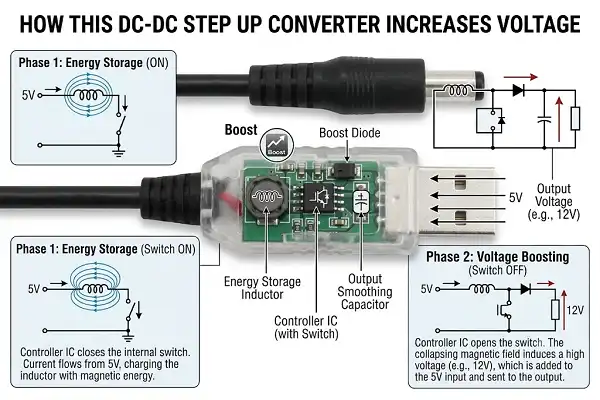
When the "on" phase is on, a DC-DC step up converter stores energy in an inductor and releases it at a higher potential when the "off" phase is on. This carefully engineered switching mechanism raises the voltage. According to basic electromagnetic theory, when current runs through the inductor, it creates a magnetic field. When the switch opens, the field collapses, causing a voltage spike that adds to the input voltage and makes the output higher. This method is more efficient than linear controllers, which waste a lot of power. It is essential for battery-powered devices, green energy systems, and industrial equipment that needs stable high-voltage rails from lower-voltage sources.
Engineers and procurement managers can make better choices about power supply architectures, component selection, and system reliability when they know how voltage transformation works on a technical level.
Understanding the Basics of Boost Converter Operation
The Core Components Working Together
There are four important parts in every DC-DC step up converter that work together to raise the voltage. Inductors store energy in the form of a magnetic field that holds power temporarily. A fast semiconductor switch, usually a MOSFET, goes back and forth between conducting and blocking thousands of times every second. When the diode is present, it stops the flow of reverse current and sends energy to the output. Finally, capacitors smooth out voltage changes so that linked loads get clean, stable power. To get the best performance with a wide range of load conditions, these parts must be perfectly matched to the input voltage ranges, switching speeds, and cooling needs.
When choosing parts, paying attention to details like inductor peak current, MOSFET on-resistance, and diode forward voltage drop has a direct effect on how well the whole system works. We've seen that a lot of procurement teams forget about these little things, which leads to early failures or poor performance in tough industrial settings.
How the Switching Cycle Creates Higher Voltage?
To charge, the switch is closed, and current flows from the input source to ground through the inductor. This creates magnetic energy. The diode stops current from going to the output when input voltage shows up across the inductor. A voltage spike is made by the inductor to resist the sudden change when the switch opens quickly. This causes a voltage to add to the input voltage in a mathematical way, which flows current through the diode, which is now forward-biased, and into the output capacitor and load. The output capacitor keeps the voltage steady during the next charging cycle. This makes the power supply constant, even though the energy is transferred in pulses.
The output power is based on the duty cycle, which is the amount of on-time to total cycle time. Higher duty cycles make voltage gains bigger, but they also put more stress on parts and make them less efficient. Modern controllers change the duty cycle on the fly based on changes in input and load demands. This keeps regulation within very tight ranges.
Synchronous Versus Non-Synchronous Designs
A standard Schottky diode is used for the rectifier function in non-synchronous converters, which makes them easier to use and less expensive. In synchronous designs, this diode is swapped out for a second MOSFET that actively switches in the opposite direction of the main switch. It cuts down on conduction losses by a lot when the current is high because MOSFETs have lower forward voltage drops than diodes. Synchronous correction, on the other hand, adds complexity through dead-time management and needs more advanced control circuits.
Our USB to 12V boost converter uses smart IC technology that makes the best use of switching patterns to give you the best performance across the whole load range. This smart protection keeps an eye on the flow of current all the time and changes how it works to avoid overcurrent situations while keeping the 12V output stable from 5V USB sources. The design strikes a good mix between speed and dependability, making it good for surveillance cameras, remote routers, and solar-powered gear.
Key Advantages and Applications Across Industries
Efficiency and Thermal Management Benefits
Modern DC-DC step up converter technology has measured benefits that lead to better system performance and lower costs of doing business. Knowing these benefits helps procurement pros explain investing in parts and guess how much they will be worth in the long run.
A high conversion efficiency cuts down on wasted energy and heat production directly. Our professional-grade converters are over 90% efficient thanks to smart switching control and careful choice of components. This efficiency advantage is very important for battery-powered devices that need every watt to run, and for electronics enclosures with a lot of components that need to get rid of heat quickly. Less heat production makes parts last longer, lowers the need for cooling, and raises the efficiency of the whole system in tough industrial settings.
Managing heat isn't just about the exchanger. By lowering thermal output, parts nearby are put under less thermal stress, which lowers the failure rate of the whole assembly. We've seen big changes in the dependability of outdoor security systems that are damaged by extreme temperatures using regular power sources.
Real-World Applications Driving Industrial Innovation
One of the most difficult uses for voltage step-up technology is in solar energy devices. Depending on the amount of light hitting them, photovoltaic panels make voltages that aren't always high enough for charge controllers or battery systems to work. Boost converters effectively raise these changing inputs to stable charging levels, which increases the amount of energy collected throughout the day. Our converters work perfectly with solar panels because they change USB outputs into the 12V that battery banks and portable power stations need.
Voltage boosting is becoming more and more important for automotive electronics as cars get more complex sensor networks and communication modules. When the engine starts and when the battery is charged, the voltage changes, but sensitive electronics need steady power. To make up for these changes, step-up converters make sure that important systems keep running. Industrial IoT sensors that are placed in remote areas usually use single-cell batteries that produce 1.5V to 3.7V. However, communication modules need 3.3V to 5V rails. This gap is filled by voltage conversion, which keeps the quiescent current very low to increase the field service life.
Communication equipment, especially network infrastructure, needs power that is always on, even if the source changes. Built-in overcurrent and short-circuit safety keeps expensive networking hardware safe, and our SAE quick-disconnect interface makes connections that can withstand the weather, making it perfect for outdoor setups. Remote routers and wireless access points that get their power from movable sources stay connected all the time because the voltage is stable.
Compact Design Enabling Modern Electronics
As consumer electronics and industrial devices get smaller, they need power solutions that take up as little board space as possible while still providing a lot of power. Higher switching frequencies make it possible for smaller inductors and capacitors, which makes the footprint much smaller than with traditional transformer-based solutions. This makes good use of space and is very useful in small devices, wearable tech, and industrial control screens that are limited on space and need to make every square millimetre count.
Our philosophy of compact design goes beyond the size of things. We've improved the placement of components and the way heat moves through the system to get the most power out of it without lowering its reliability. The procedure for 100% electrical testing makes sure that every unit meets performance standards before it is shipped. This gives integrators faith that the units will behave the same way throughout production runs.
How to Design and Select the Right Step-Up Solution?
Matching Converter Specifications to Application Needs
Strategic component selection for a DC-DC step up converter begins with a full study of needs. Engineers have to set input voltage ranges that take into account the worst-case situations, like when batteries run out or there is a brownout. Regulation limits, ripple requirements, and transient reaction qualities should all be part of the output voltage specs. Finding out the load current profile in idle, typical, and peak operating modes tells us how much power we need and how to handle heat.
Compatibility with the input voltage range is the first step in any decision process. For battery-powered devices, you need converters that can work across the full discharge curve and keep the regulation even as the input voltage drops. Our USB-powered converters work reliably with power banks, wall adapters, and computer ports because they can handle standard 5V inputs and USB port variations. When the supply changes, it has a direct effect on the performance of precise instruments and communication equipment, so stable output voltage is very important.
Comparing Alternative Voltage Conversion Approaches
The ability to handle load current must be able to handle both steady and changing needs. Pulsed current draw is seen in many applications, such as when wireless transmitters send packets or when motors start up. This is something that converters have to do without letting the voltage drop or going into protection modes. We give both continuous and peak current values, so there is room for error in the real world. The highest current that can flow is affected by temperature, especially in enclosed sites or places with high temperatures.
Linear regulators are easy to use and make little noise, but they can only step down the voltage and give off a lot of heat. They work well for low-power tasks with small differences in input and output voltage, but they can't be used to boost voltage or deal with large amounts of power. Charge pump converters use switching and capacitor networks to increase voltage. They work well for low-current uses but are less efficient at higher loads than systems that use inductors.
Transformer-based isolated converters change voltage while keeping galvanic isolation, which is important for medical equipment that needs to be safe and systems that are linked to the grid. But compared to non-isolated boost converters, they are more complicated, cost more, and take up more space. Non-isolated boost designs work best for most battery-powered and automotive uses that share ground reference points. Our main line of products is these small, high-efficiency solutions that can be used in a huge variety of business and industrial settings.
Practical Selection Criteria for Procurement Teams
Certification compliance ensures that you can get into markets and lowers the regulatory burden. Our converters have been approved by CE, VDE, FCC, RoHS, and REACH, which means they meet the standards of many major global markets. This complete agreement takes away any worries about area limits and environmental rules. Warranty coverage protects against problems with the way the product was made. Our normal 1-year promise protects customer investments and shows that we trust our quality control processes.
Because they can be customised, converters can easily fit into current product environments. We can make cables to any length, shape, or configuration, including custom RJ45 pinouts and OEM branding. We can also package your products in your own brand name. Colour matching makes sure that customer products look the same. These flexible choices help brands stand out while using tried-and-true power conversion platforms. Rapid prototyping is possible with samples that can be sent within 3–7 business days, and bold product launch dates can be met with large production that can be finished within 15–25 days.
High-Performance Solutions from Leading Manufacturers
Industry-Leading Brands and Technologies
As new semiconductor materials, control methods, and integration densities come out, the global market for DC-DC step up converter technology keeps changing. Well-known companies put a lot of money into research and development, which makes them more efficient and lowers the cost of solutions by taking advantage of economies of scale.
Texas Instruments stays ahead by offering a wide range of products for applications ranging from micro-power to multi-kilowatt. Their integrated solutions put power stages and complex control loops on the same silicon die, which cuts down on the number of parts and board space needed. Analog Devices focuses on high-precision and low-noise performance for high-resolution data acquisition systems and instruments. Murata's module method puts inductors, switches, and control circuits in shielded cases, which makes design easier and speeds up time-to-market.
These leaders in technology set standards for performance, but for many types of applications, specialised manufacturers offer better value. Kuncan Electronics has been making wire and power accessory solutions for 17 years, and they know how to make designs work best for network equipment, solar uses, and portable electronics. This specialisation lets you learn more about what customers are having trouble with and make it easier to connect products that work together.
Current Market Trends Shaping Product Development
Miniaturisation is still driving innovation in parts. For example, multi-chip systems with full power stages that are only millimetres on each side have been made. Gallium Nitride (GaN) transistors can switch at higher frequencies and handle more power than regular silicon MOSFETs, but because they are more expensive, they are mostly only used in high-end applications right now. Programmable converters with digital control interfaces let software orders change the output voltage, current limits, and safety levels in real time.
Another important trend is the rise of smart protection features. Advanced converters have more features than just basic overcurrent and overvoltage safety. They also have thermal tracking, soft-start sequencing, and full problem reports. Our smart IC constantly checks the flow of power, keeping connected devices safe and achieving the best efficiency even when the load changes. This approach to security cuts down on field failures and makes it easier to figure out what's wrong when it does happen.
Strategic Sourcing Considerations for B2B Buyers
Strategies for buying in bulk have a big effect on the total cost of ownership. Most of the time, promises to buy in bulk lead to better prices. However, the per-unit savings must be weighed against the costs of keeping supplies and the risk of becoming obsolete. We allow small-batch replenishment and don't have minimum order quantities, so customers can get the most out of their inventory while still being sure they'll have enough supplies. Different levels of urgency can be met at the lowest cost by using a variety of shipping methods, such as air, ocean, and rail.
Reliability in a supplier goes beyond the quality of the product to include how quickly they respond to communications, how much professional help they offer, and how stable their supply chain is. Our varied raw material supply chain lessens the effects of component shortages, and we keep our delivery promises even during times when the industry allocates materials. The steps of incoming, in-process, and final inspection make sure that quality standards are met, and the 24-hour reaction time for urgent orders takes care of project needs that come up out of the blue. We are in the industrial center of Dongguan, which gives us access to a stable environment of suppliers and transportation providers that help our operations run smoothly.
Troubleshooting Common Issues and Maximizing Efficiency
Addressing Electromagnetic Interference Challenges
Due to fast changes in current in inductors and PCB traces, switching DC-DC step up converters naturally make electromagnetic noise. Through electric and magnetic fields, this noise can connect to circuits next to it and mess up sensitive analogue signals or cause radio frequency interference. To reduce EMI, make sure that switching lines have as few loops as possible, use ground planes for shielding, and put input/output filtering capacitors close to the converter inputs.
When fumes are conducted, they go back through the power lines that brought them in, which can damage circuits further upstream or break the rules. These emissions are lowered by using common-mode chokes and differential capacitors for input filtering. Our converters have built-in filtering that works best with USB power sources. This makes sure that they work with host devices and are FCC compliant. Shielded enclosures offer extra protection in places with strong electromagnetic fields.
Optimizing Thermal Performance in Real Installations
Choosing devices with enough current ratings and low on-resistance is the first step in thermal management. To make sure they are reliable, converters should work well below their maximum temperature ratings. The copper on the PCB spreads heat away from power components and toward the walls of the box or heat sinks. Thermal vias move heat from the pads of components to the board's internal ground planes and other surfaces.
Ambient temperature requirements need to take into account the worst-case scenarios, such as solar heating, nearby heat sources, and sealed enclosures that don't let air flow through them as easily. Our industrial-grade versions can handle temperatures ranging from -40°C to +85°C, making them perfect for outdoor security cameras and solar setups that are exposed to big changes in temperature. Derating guidelines help engineers predict how performance will change across temperature ranges. This keeps systems from shutting down or losing their ability to produce as much.
Preventing Common Application Mistakes
Load impedances that don't match up often lead to instability or the start of safety modes. The values of output capacitance affect the stability of the loop, especially in voltage mode control architectures. Too little capacitance can cause oscillations or slow startup, while too much capacitance can cause too much voltage ripple and poor transient response. Stable operation is guaranteed if you follow the manufacturer's advice on the type of capacitor, its number, and its equivalent series resistance (ESR).
The limits on the input voltage must be strictly followed. When you go over the maximum input ratings, parts get damaged, and when you operate below the minimum input thresholds, you get dropout or regulation loss. Applications that use batteries should have undervoltage safety circuits that stop the converter from working when the batteries are fully discharged. Our smart protection technology checks the input parameters and either lowers output or turns off the device when conditions get too high for safe operation.
Conclusion
Voltage step-up conversion is an important technology that makes modern gadgets work, from collecting energy from green sources to portable phones, and a DC-DC step up converter sits at the heart of these systems, transforming lower input voltages into stable higher outputs to power microcontrollers, displays, and wireless modules. Engineers can make strong power systems, and procurement workers can make smart buying choices when they understand electromagnetic principles, how components interact, and design trade-offs. Professional-grade solutions are set apart from inferior ones by their efficiency, security features, and thermal management, all of which have a direct effect on system stability and total cost of ownership. As applications need higher power densities and tighter integration, working with manufacturers with a lot of experience is becoming more and more important for navigating technical challenges and making sure the supply chain stays stable over the long term.
FAQ
What efficiency should I expect from a quality boost converter?
Depending on the input voltage, output voltage, load current, and switching frequency, a professional-grade DC-DC step up converter can usually get between 90% and 96% efficiency. When loads are average, efficiency is highest. When currents are very light or very heavy, efficiency goes down. Our USB to 12V converter stays over 90% efficient over a wide range of normal working conditions. This keeps heat to a minimum and extends battery life in portable devices.
Can boost converters operate when input voltage exceeds output voltage?
When the input voltage goes above the output voltage, standard boost topology converters can't control it because the current flows straight through the inductor and diode, skipping the control circuitry. Input voltages above and below the output voltage can be handled by buck-boost or SEPIC topologies. This lets them regulate a wider range of input voltages. During the design phase, the needs of the application should lead the choice of topology.
How do I choose between synchronous and non-synchronous designs?
Non-synchronous converters are easy to use and don't cost as much. They're good for low-current situations where the diode forward voltage drop doesn't have a big effect on efficiency. When the current is high, and MOSFET conduction losses are much higher than diode losses, synchronous designs are worth the extra complexity. For certain projects, this choice is based on budget limits, energy efficiency goals, and thermal limits.
Power Your Projects with Kuncan Electronics' Voltage Conversion Solutions
Kuncan Electronics creates professional-grade DC-DC step up converters and has been making them precisely for 17 years, helping global integrators and equipment manufacturers. Our USB to 12V boost converters come with smart security, 100% electrical testing, and a lot of different customisation choices so they can meet the needs of demanding network equipment, solar applications, and portable electronics. We offer full OEM/ODM services, including custom wire lengths, connector configurations, and private label packing. We can also do quick samples in 3–7 days and large production in 15–25 days. We are a reputable manufacturer, and we keep our supply chains diverse, have full global certifications, and provide quick technical support to make the buying process easier. Email our team at rhea@szkuncan.net to talk about your voltage conversion needs and find out how our solutions can improve your supply chain's reliability and efficiency.
References
1. Erickson, R.W. & Maksimovic, D. (2020). Fundamentals of Power Electronics (3rd ed.). Springer International Publishing.
2. Kazimierczuk, M.K. (2015). Pulse-width Modulated DC-DC Power Converters (2nd ed.). John Wiley & Sons.
3. Pressman, A.I., Billings, K., & Morey, T. (2009). Switching Power Supply Design (3rd ed.). McGraw-Hill Education.
4. Basso, C.P. (2012). Designing Control Loops for Linear and Switching Power Supplies: A Tutorial Guide. Artech House Publishers.
5. Maniktala, S. (2014). Switching Power Supplies A-Z (2nd ed.). Newnes Publishing.
6. Brown, M. (2001). Practical Switching Power Supply Design. Academic Press.

USER EVALUATE
Here is the customer's evaluation of us
YOU MAY LIKE
 VIEW MOREbritish power cords
_1781163912838.webp) VIEW MORENEMA 5-20P to T-Blade Receptacle Adapter Cord
VIEW MORENEMA 5-20P to T-Blade Receptacle Adapter Cord VIEW MORE12V Car Female Socket with Fuse and Eyelet Terminal
 VIEW MORE12v dc power supply for led lights
 VIEW MOREiec kettle lead
 VIEW MORENEMA5-15P to stripped and tinned Power Cord
 VIEW MOREIndustrial AC/DC Adapter
 VIEW MOREpower supply 12 volt 5 ampere