


Why Wall Mounted AC Adapters Fail Compliance Checks
A wall mounted AC adapter that fails a compliance check does not simply get returned. It stalls an entire product launch, triggers regulatory penalties, and can damage brand reputation across multiple markets. Procurement professionals in commercial HVAC, industrial automation, and consumer electronics sectors face this reality routinely. Understanding exactly why these power supply units fail—and how to prevent it—is the most practical investment a B2B sourcing team can make before placing a bulk order.
Understanding Compliance Requirements for Wall Mounted AC Adapters
It's hard to follow the rules that govern AC-to-DC power supplies. UL 60950-1 and UL 62368-1 set safety rules for power adapters in the US. The EU also needs CE marking, which is part of the Low Voltage Directive. RoHS restricts the use of dangerous substances, and ISO guidelines cover how to keep quality high. Each method focuses on a different kind of failure, such as regular, electrical, or environmental.
What Do Regulators Actually Scrutinize?
It is important for regulators to check the output voltage range, the insulation resistance, the surge handling capacity, and the temperature performance when the load is on for a long time. Greater than ±5% changes in voltage can lead to false shutdowns or damage that can't be fixed in HVAC systems made by Samsung, LG, and others. This is because adapters power the control boards. Making sure that every unit that leaves the plant is the same as the approved prototype is another way that compliance verification keeps the supply chain safe.
Common Reasons Why Wall Mounted AC Adapters Fail Compliance Checks
Compliance failures cluster around three root causes: design deficiencies, manufacturing inconsistencies, and documentation gaps. Each category carries distinct consequences for procurement teams.
Substandard Components and Improper Voltage Configuration
One of the most common risks when sourcing a wall mounted AC adapter is component substitution during production. A supplier may certify a prototype using high-quality capacitors and then replace them with lower-rated alternatives during mass production, potentially increasing output ripple, reducing thermal stability, and causing the finished product to deviate from its certified specifications. For buyers evaluating a wall mounted AC adapter, this risk highlights why checking a certificate alone is not enough to establish consistent product quality. Procurement teams should request batch-level material traceability, approved component lists, and production inspection records to verify that mass-produced units match the tested design. They should also ask suppliers to document any component changes and explain how those changes are assessed before implementation. When purchasing a wall mounted AC adapter in bulk, buyers can strengthen quality assurance by reviewing sample test results, incoming material controls, and final electrical performance reports. These checks help identify inconsistencies before products reach customers and reduce the risk of unexpected failures in the field. By requiring traceable components and consistent manufacturing controls, businesses can source a wall mounted AC adapter with greater confidence in its reliability, safety, and conformity to the approved specifications.
Improper voltage configuration compounds the risk. An adapter rated at 12V DC but delivering 13.4V under light load conditions will pass a casual visual inspection yet destroy sensitive control boards over time. Matching the output rails precisely to the PCB's tolerance window is non-negotiable, particularly for industrial automation equipment operating at temperature extremes from -40°C to +85°C.
Installation Errors and Maintenance Neglect
Even a certified unit can fall out of compliance through incorrect field installation or prolonged maintenance neglect. Loose terminal connections generate resistance heat. Dust accumulation on ventilation slots raises the internal ambient temperature. Both conditions accelerate capacitor aging and push the unit outside its rated performance envelope. Routine voltage testing and thermal inspections—conducted at intervals aligned with manufacturers like Mitsubishi and Panasonic—preserve compliance status throughout the product lifecycle.
Incomplete Testing Procedures and Missing Documentation
Testing gaps represent a subtler but equally serious failure mode. Some suppliers submit only partial test reports, omitting dielectric withstand tests or conducted emissions measurements. Without a complete technical file, customs authorities and end-clients cannot independently verify certification authenticity. A 2021 CPSC enforcement review found that incomplete documentation was a contributing factor in nearly 28% of recalled power supply products in the US market.
Troubleshooting and Preventing Compliance Failures: Best Practices for B2B Clients
For effective compliance management, you need structured systems, not quick fixes. These are the main things that know-it-all buying teams always do.
These rules lower the chance of not following the law at all stages of the buying and deploying process:
Before the goods are shipped, the plant should be checked to make sure that the parts of the production line match the approved Bill of Materials. Check the thickness of the copper traces and make sure you know the brand of the capacitors before the bulk release. Load testing: As soon as you get it, test a statistical sample at full rated load for at least two hours. It's important to keep an eye on the case temperature, output voltage, and current draw. "Installation alignment with OEM guidelines" means that you should follow the torque and wiring instructions that HVAC brands like Daikin and Panasonic post. Changes in the direction of current cause ground loops and leakage paths that fail insulation resistance tests.
- Pre-shipment factory audits: Verify that the production-line components match the certified Bill of Materials. Request copper trace thickness reports and capacitor brand confirmations before bulk release.
- Incoming inspection with load testing: Upon receipt, test a statistical sample under full rated load for a minimum of two hours. Log output voltage, current draw, and case temperature. Compare against certified thresholds.
- Installation alignment with OEM guidelines: Follow the specific torque and wiring specifications published by HVAC brands such as Daikin and Panasonic. Deviations create ground loops and leakage current paths that fail insulation resistance tests.
- Scheduled maintenance intervals: Conduct quarterly visual inspections for dust ingress and connector oxidation. Annual voltage calibration checks confirm the adapter has not drifted from its certified output range.
Compliance goes from being a one-time approval event to a rule that is always followed when these steps are taken. When you compare how much it costs to recall a product or shut down a system in a real business setting, these checks are a steal.
How to Select Compliant and Reliable Wall Mounted AC Adapters for Your Business
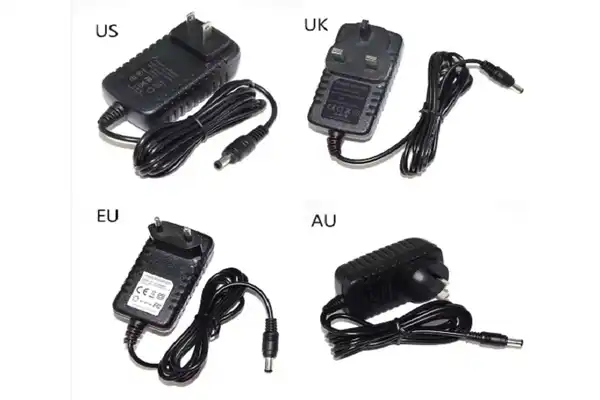
Choosing the right power supply requires more than reading a product description, especially when comparing a wall mounted AC adapter with a plug-in desktop adapter for commercial or industrial applications. This article examines the key factors business buyers should consider, including installation method, certification scope, voltage stability, plug interchangeability, OEM customization, and intended use. A wall mounted AC adapter offers a compact, integrated design that can reduce cable clutter, making it suitable for installations where space is limited and a fixed power connection is preferred. By contrast, a desktop adapter may provide greater flexibility when equipment is positioned farther from a wall outlet, although cable management can require additional attention. When evaluating a wall mounted AC adapter, procurement teams should verify the relevant certifications and compliance documentation, which may include UL, CE, ETL, VDE, or RoHS-related documentation, depending on the product and target market. They should also check output voltage stability, rated power, connector compatibility, and available plug configurations for the United States, Europe, the United Kingdom, and Australia. For businesses with specific requirements, OEM customization options for cable length, barrel jack size, and logo printing can further improve product compatibility. The ideal choice depends on the application: a wall mounted AC adapter may suit commercial HVAC controls, telecommunications equipment, and certain medical devices when its electrical ratings and approvals meet the equipment requirements. Comparing these factors helps buyers select a suitable wall mounted AC adapter and make more informed bulk purchasing decisions.
| Evaluation Criterion | Wall Mounted Adapter | Plug-In Desktop Adapter |
|---|---|---|
| Installation Method | Fixed wall mount, reduced cable clutter | Requires outlet proximity, cable management burden |
| Certification Scope | UL, CE, RoHS, ETL, VDE options | Typically UL/CE only |
| Voltage Stability | Optimized for continuous fixed-load operation | Variable; prone to sag under sustained load |
| Plug Interchangeability | US, EU, UK, AU snap-in modules available | Region-locked by design |
| OEM Customization | Cable length, barrel jack size, logo printing | Limited customization options |
| Ideal Application | Commercial HVAC, telecom, medical devices | Consumer peripherals, low-duty devices |
A power charger with AC plugs that can be switched between US, EU, UK, and AU standards gets rid of SKU fragmentation when buying things from around the world. This makes it easier to manage inventory across regional stores.
Why Kuncan's Multi-Specification Power Adapter Addresses These Criteria
A wall-mounted power charger made of high-tolerance ABS plastic is designed by Kuncan Electronics. It has snap-in plug units that are held in place by a rail-and-groove locking system. It can handle 100–240V AC at 50/60Hz and sends out a steady 5V, 9V, or 12V DC at 1A, 2A, or 3A. The case is made of V0-grade flame-resistant plastic. Over-Voltage Protection (OVP) and Over-Current Protection (OCP) circuits make sure that the unit turns off very quickly after a grid spike. The 12V 3A version has ripple and noise levels that stay below 120mVp-p even when it's fully loaded. This is very important for medical monitoring equipment and equipment that is sensitive to RF.
Case Studies: Real-World Instances of Compliance Failures and Mitigations
A North American company supplying HVAC equipment purchased a wall mounted AC adapter from a supplier that had not undergone a thorough qualification process. During installation, technicians tested adapters from the same production batch and measured output voltages ranging from 11.2V to 13.8V, revealing significant inconsistencies in power delivery. These variations caused the LG control boards to behave unpredictably, forcing the company to replace the adapters across all 200 units. A subsequent investigation attributed the problem to undocumented capacitor substitutions during manufacturing, which may have affected the adapters' electrical performance. This case highlights why buyers should carefully evaluate suppliers before purchasing a wall mounted AC adapter in bulk. Procurement teams should request batch-level test reports, approved component lists, and material traceability records to confirm that every wall mounted AC adapter matches the validated design. They should also verify output voltage tolerance, load regulation, and quality control procedures before approving mass production. For HVAC applications, an unreliable wall mounted AC adapter can lead to equipment malfunctions, costly field replacements, and customer dissatisfaction. By choosing a qualified manufacturer and requiring consistent electrical testing, businesses can reduce sourcing risks and improve the reliability of every wall mounted AC adapter delivered to their customers.
In a different case, a company that makes telecom equipment and ships ONT units all over the world discovered that the adapter plug heads were physically coming loose from the main housing while testing for vibration. There was a clear breach of the IEC 60068-2-6 mechanical stress rule. Why was it broken? The plug link wasn't physically locked; it was just stuck together with glue. The problem was fixed by moving to a supplier with a documented locking track system. This brought all regional markets back into line.
We learn the same thing from both situations: we need to check out the supplier, find the parts, and make sure the machine works right.
Conclusion
Compliance issues involving a wall mounted AC adapter often arise from preventable problems, including unauthorized component substitutions, incorrect voltage configurations, insufficient testing, and incomplete documentation. These issues can lead to regulatory delays, product failures, and costly replacements, making supplier evaluation essential for businesses sourcing a wall mounted AC adapter in bulk. Procurement teams can reduce these risks by establishing structured quality assurance procedures, such as factory audits, incoming inspections, and load testing before products are approved for distribution. When evaluating a wall mounted AC adapter, buyers should also verify output voltage and current ratings, applicable safety certifications, component traceability, and consistency between the approved design and mass-produced units. Reliable suppliers should maintain clear production records and provide supporting test reports and compliance documentation relevant to the intended market. For OEM buyers, access to engineering support and customization capabilities can further help ensure that a wall mounted AC adapter meets specific equipment requirements without compromising safety or performance. By partnering with a manufacturer that emphasizes traceable materials, recognized certifications, and consistent quality control, businesses can turn compliance management into a competitive advantage. A carefully selected wall mounted AC adapter supplier can help streamline procurement, improve product reliability, and build customer confidence across international markets.
FAQ
What certifications should a wall mounted AC adapter carry for the US market?
62368-1 says that a power adapter must have at least UL or ETL certification in order to be sold in the US. The item must have a CE mark in order to be sold in the EU. To keep the amount of dangerous materials in the PCB and housing to a minimum, both must comply with RoHS.
How do I verify that the production batch matches the certified prototype?
To get what you need, ask for a Bill of Materials (BOM) that lists all the parts and their part numbers, along with a signed statement of conformance. There is a type-tested unit that you can use to compare the names of the capacitors and transformers. A third party checking a batch of proof on its own leaves the most faith in it.
What output voltage tolerance is acceptable for HVAC control board compatibility?
Most industrial HVAC control boards can have an input voltage that is up to 5% off from what it should be. In robots for business and medicine, work needs to be done with more accuracy. Check the adapter manufacturer's instructions before making any final changes to the settings for the output.
Can interchangeable plug modules affect electrical compliance?
When plug units are under mechanical stress, they must always have a pin-to-contact resistance of less than 10m©. If the module isn't properly latched, it can cause the emissions test to fail because it raises contact resistance and makes heat.
Partner With a Certified Wall Mounted AC Adapter Manufacturer — Kuncan Electronics
Kuncan Electronics has been a power supply engineer for 17 years, so they can help you with your sale. AC plugs that we place on the wall have been approved by ETL, CE, VDE, RoHS, and SAA. We can also print branding and change the length of the wire or the size of the barrel jack as an OEM or ODM service. Large orders are shipped between 15 and 25 days after they are placed. Send an email to rhea@szkuncan.net to talk to our engineering team about your compliance needs and get a technical quote.

References
1. International Electrotechnical Commission. IEC 62368-1: Audio/Video, Information and Communication Technology Equipment – Safety Requirements. IEC, 2023.
2. U.S. Consumer Product Safety Commission. 2021 Annual Report on Product Recalls and Safety Enforcement. CPSC, 2021.
3. Underwriters Laboratories. UL 60950-1 and UL 62368-1 Transition Guide for Power Supply Manufacturers. UL Standards, 2022.
4. European Commission. Low Voltage Directive 2014/35/EU: Compliance Guide for Electrical Equipment. Official Journal of the European Union, 2014.
5. IEC Technical Committee 61. IEC 60068-2-6: Environmental Testing – Vibration Sinusoidal Test Methods. IEC, 2020.
6. RoHS Alliance. RoHS Compliance Handbook: Restricted Substances in Electrical and Electronic Equipment. RoHS Alliance Publications, 2022.

USER EVALUATE
Here is the customer's evaluation of us