


How US to IEC C5 Power Cord Solves Laptop Adapter Compatibility Problems?
A cloverleaf connector that won't fit your laptop adapter feels like finding the right key but the wrong lock. The US to IEC C5 Power Cord solves laptop adapter compatibility problems by bridging the gap between North American wall outlets and international device standards through a precision-molded three-prong NEMA 5-15P plug paired with an IEC 60320 C5 cloverleaf interface. This standardized connection eliminates regional plug mismatches, ensures consistent voltage delivery across diverse equipment, and supports safe 10A current flow to power adapters from leading brands like HP, Dell, Lenovo, and Acer without overheating or connection failure during continuous operation.
Understanding the Laptop Adapter Compatibility Challenge
What Is a US to IEC C5 Power Cord and Why Does It Matter?
Compatibility issues with laptop adapters are still a problem in global B2B procurement settings where workers from different regions use equipment from other regions. A power cord that connects US outlets to laptop adapters needs to meet two requirements: it needs to be physically compatible with both the wall and the device's input, and it also needs to be able to handle continuous power loads without breaking down.
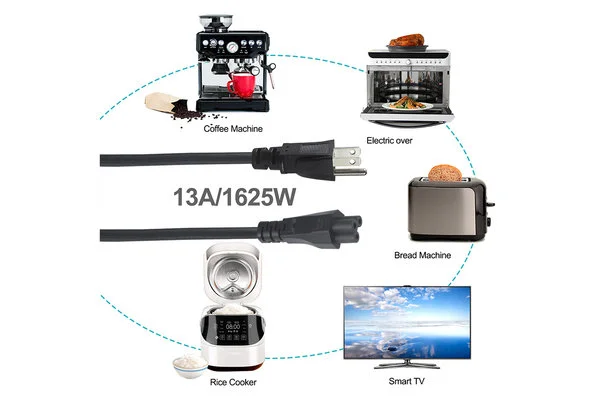
On one end of the cloverleaf power cable is a NEMA 5-15P three-prong plug that fits standard 120V North American wall outlets. On the other end is an IEC 60320 C5 connector. The three-hole design of this C5 interface, which makes it popularly known as a "Mickey Mouse" plug, has made it the standard for small electronics. The electrical rating of 125V AC at 10 amps makes sure that high-performance laptop adapters can work. These adapters change AC mains power to DC voltage so that batteries can be charged and processors can be powered.
Common Compatibility Problems That Disrupt Operations
When putting laptop fleets in different corporate locations, procurement teams keep running into problems. Plugs from different regions have different shapes and sizes, so a European Schuko plug won't fit in a US outlet without an adapter, which adds more places where things could go wrong. Connector mismatches happen when supply chain teams order IEC C7 figure-eight wires for devices that need C5 inlets. This leaves them with stock that can't be used and delays launches.
These mistakes have real-world effects that can be measured. When workers can't power their computers during important project stages, operational downtime builds up. When users force connectors that don't work with the device into its ports, they break retention clips or bend contact pins, which damages the hardware. It costs more than just to replace the broken equipment. Lost output during breakdowns and faster shipping fees for emergency replacements put a strain on operations budgets.
How Cable Length Affects Deployment Efficiency
The standard length of 1.8 meters (6 feet) is the result of careful engineering balance. Shorter cords make it harder to move things around, so desks have to be closer to wall outlets and workspaces can't be set up in a variety of ways. Too much length makes it hard to handle the cables; loose coils can cause trips in areas with a lot of foot traffic and cause electromagnetic interference when bundled with data cables in computer racks.
With our improved cable reach, computers sitting on tables can connect to power strips on the floor without putting stress on the adapter brick. This length works for conference room projector setups where the equipment is on the center tables and the power outlets are along the walls around the room. The distance keeps the C5 connector from being stressed during daily use, so it lasts longer than the usual three years between corporate equipment replacements.
Key Differences Between US to IEC C5 and Other Power Cords
Connector Shape and Device Alignment
Costly buying mistakes can be avoided by understanding the different types of connectors. The IEC C7 adapter looks like a figure-eight and has two round holes. It is made for double-insulated devices that don't need ground connections, like older audio equipment and portable DVD players. When you put the C5 cloverleaf between two power contacts, it creates a triangle-shaped footprint that makes it physically impossible to place it into the C7 device inlets.
IEC C13 connections are rectangular and have three blade-shaped contacts arranged in a row. These connectors are commonly found on desktop computers, monitors, and network switches. Compared with the C5 connector, C13 is generally used for equipment with higher current requirements. When selecting a US to IEC C5 Power Cord, users should first confirm that the equipment has a compatible C19 inlet and that the NEMA 5-15P plug matches the available receptacle. A US to IEC C5 Power Cord should not be confused with a C13 or C5 power cord, because the connector shapes and intended applications are different. Checking connector compatibility before installation helps prevent incorrect connections and potential equipment damage. Properly identifying the required US to IEC C5 Power Cord can therefore help users avoid compatibility problems and ensure a suitable power connection. A reliable US to IEC C5 Power Cord should always be selected according to the equipment specifications and applicable electrical requirements.
Electrical Ratings and Safety Implications
The safe working limits are directly linked to the amperage number that is stamped on each cord jacket. Our 16 AWG copper conductors can safely carry 10 amps continuously without getting too hot. Putting an 18 AWG C7 cable that is only rated for 2.5A on a high-performance laptop adapter that draws 8A causes dangerous heat buildup inside the insulation. The internal resistance causes heat that breaks down PVC compounds, which can cause shielding to fail and pose a fire risk.
When buying something from another country, voltage rates are just as important. The C5 socket can literally handle 250V AC across borders, but the NEMA 5-15P plug can only connect to 120V systems in North America. When purchasing for sites overseas, procurement teams must specify regional plug versions while keeping the C5 device connector. Combinations such as UK BS 1363 to C5 or European CEE 7/7 to C5 stop voltage mismatch situations that damage equipment made for different input ranges.
Material Construction and Certification Standards
Real laptop power cords have 100% bare copper conductors instead of copper-clad aluminum ones that have higher resistance and less mechanical flexibility. The SVT (Service Vacuum Thermoplastic) jacket material is more flexible than the heavier SJT compounds. This means that wires can go through tight areas behind desks without getting tangled. In high-density office spaces where many cables meet at shared power strips, this flexibility is very important.
Safety certificates back up the choices of materials and the ways they are made. UL and cUL marks show that the product meets North American standards. RoHS approval makes sure that dangerous materials don't exist, like lead in solder joints or cadmium in PVC stabilizers. A lot of fake cables have fake certification marks printed directly on the jackets. Real cables, on the other hand, have text that is molded into the jackets during the manufacturing process and can't be taken off without damaging the jacket.
Why US to IEC C5 Power Cord Is an Optimal Choice for Global B2B Clients
Robust Design for Demanding Environments
When laptops are used at work, the power lines are put through mechanical forces that aren't common in homes. Employees test the connector retention force every day by docking and undocking portable workstations. Our precisely molded C5 receptacle keeps the contact pressure high with copper alloy spring contacts that don't wear out after thousands of insertion cycles. This directly matches the five-year service life expectations in enterprise settings.
The strain relief design built into both ends stops a common failure mode where repeated bending wears down the copper strands where rigid connections meet flexible wire. Heavy-duty molded boots spread mechanical tension over a wide area, so there are no areas where stress builds up. This little bit of engineering is very important when people move furniture and accidentally pull on cables or when cleaning teams vacuum around desks without unplugging anything.
Customization Options That Match Operational Requirements
Standard 6-foot lengths work for most desk setups, but custom solutions are needed for certain settings. 3-foot versions are better for data center setups because they cut down on extra cable in rack-mounted equipment, which lowers electromagnetic interference and makes managing airflow easier. For setups in conference rooms, 10-foot choices may be needed to connect wall outlets to presentation equipment on the center table without showing any extension cords.
In addition to different lengths, we can also use color-coding systems that help facility management teams keep track of the inventory of tools in many areas. Custom jacket colors, like blue for IT equipment and gray for AV setups, make it easier for repair workers to figure out what's wrong with power in complicated installations. When OEM partners group our cords with their own laptop adapters, printing logos on the connection overmolds helps them remember our brand.
These skills come from the 17 years that Kuncan Electronics has been making things. Because we are flexible in how we make things, we can accept custom orders for as few as 500 units, which means you don't have to worry about the high costs of keeping too much inventory on hand.
Real-World Impact on Operational Continuity
When generic replacement cords were used, a regional healthcare network with 800 mobile diagnostic workstations experienced recurring power problems. Loose C5 connections sometimes caused power interruptions while doctors were examining patients, requiring equipment to be restarted and increasing the time needed to complete diagnostic procedures. For equipment that specifically requires a C19 connection and a NEMA 5-15P receptacle, a properly specified US to IEC C5 Power Cord can help provide a secure and reliable power connection. After switching to precision-molded assemblies with controlled retention characteristics, the facility reduced connection-related problems across compatible equipment. Selecting a reliable US to IEC C5 Power Cord can help minimize avoidable connection issues when the configuration matches the equipment and electrical system. For demanding environments, a properly manufactured US to IEC C5 Power Cord can support consistent power delivery and reduce unnecessary equipment interruptions.
A manufacturing engineering company chose our SVT power cords as the standard for portable test equipment that is used for inspections in the field. The bendable jacket could be wound up and carried around in tool bags many times without cracking, as their old vendor's cords did. Because the cables were so durable, they didn't have to be replaced as often—every 18 months instead of every four years—which cut down on the cost of buying new ones and the time field technicians had to miss important client site visits.
How to Select and Procure the Right US to IEC C5 Power Cord
Technical Criteria That Define Quality
The amount of amps needed must match the needs of the device. For example, the rating labels on laptop adapters usually list the input current. A 90W adapter running at 120V draws about 0.75A, which is well within our 10A range. However, high-performance gaming laptops with 180W adapters may draw 1.5A, so making sure the wire gauge is right is important to keep the voltage from dropping. Even at extended maximum loads, our 16 AWG wires make sure that there is very little resistance.
In places with a lot of electromagnetic noise, like factories that use variable frequency drives and spark welding tools, how well the shielding works is important. Basic laptop ports work fine with cords that aren't shielded, but medical diagnostic equipment that is sensitive needs shielded cords so that RF interference doesn't mess up low-voltage sensor data. We offer braided shield options that are optional and cover 95% of the cable, successfully blocking external electromagnetic fields without making the cable much stiffer.
The quality of a connector can be felt; real molded connectors have smooth surfaces that don't have any parting lines or flash that can be seen from the injection molding process. The C5 contacts should have even coating coverage. Usually, nickel is used as an undercoat, and gold flash is added to the connecting sides to stop oxidation. When you insert the connector fully into the device's opening, you should feel a firm but not too much force, and you should be able to hear a clear click.
Compatibility Across Major Laptop Brands
Even though their DC output specs are different, Dell Latitude series adapters, HP EliteBook power bricks, Lenovo ThinkPad chargers, and Acer Aspire adapters all use the same standard C5 input. This is because the IEC 60320 standard was widely adopted by the industry in the 1990s, when companies realized that standard AC input connectors would make the supply chain more efficient.
There are still differences between brands. For example, Apple MacBook Pro adapters use a special magnetic connector on the DC output side, but earlier models had C5 AC inputs before switching to designs with built-in AC plugs. If purchasing teams are replacing old Apple adapter cords, they should check the model generation to make sure they don't order cables that won't work with newer equipment that doesn't have C5 inlets.
Strategy for Evaluating Suppliers and Buying Things
Suppliers you can trust show they can make things by getting third-party certifications instead of saying they can do it themselves. On the UL Product iQ database, you can check UL listing numbers to make sure that the samples you sent in were actually tested in a lab and not just fake ones. We offer UL file number E333364 as proof that our approval is real, which gives buying managers peace of mind that we are following the rules.
Buying in bulk has real cost benefits that go beyond lower unit prices. When packages are combined, the cost of freight per unit is lower, and when inventory is guaranteed to be available, rush order fees are avoided when urgent restocking is needed. We support volume-tier pricing that goes down as the number of units ordered goes up. This saves you a lot of money when you buy 1,000 units or more, and it keeps the same 17-year quality standards that define our consumer goods.
OEM customization turns standard cables into parts that match a brand. We put customer logos and product details on custom packages, so there is no need for extra repackaging in the delivery process. Options for barcoding and standardization help inventory tracking systems, and unique hang tags show information about device compatibility, which cuts down on calls to customer service asking if the device fits.
Future Trends Impacting the Use of US to IEC C5 Power Cords in Laptop Adapters
Evolving Safety Standards and Design Innovations
As new safety concerns are identified through field-failure analysis, industry standards continue to evolve. Updated testing requirements can place greater emphasis on connector retention and mechanical stability to better reflect real-world conditions, including the weight and movement of cables connected to equipment. For applications using a US to IEC C5 Power Cord, appropriate connector retention and mechanical durability are important factors in maintaining a secure connection during normal operation. Our engineering team actively follows developments in relevant standards and incorporates applicable requirements into production specifications before they become mandatory. This approach helps ensure that each US to IEC C5 Power Cord is designed and manufactured with attention to electrical performance, mechanical stability, and applicable safety requirements. By selecting a properly tested US to IEC C5 Power Cord, buyers can improve confidence in connection reliability and long-term performance.
Energy-saving rules force new developments in conductor materials and jacket formulas. Reduced-resistance conductor designs keep voltage drop to a minimum along cable length, which makes the system more efficient when used by thousands of corporate workstations. We're working on low-smoke, zero-halogen jacket compounds that meet stricter building code standards for plenum-rated installs. This will let our cords run through suspended ceiling spaces with HVAC systems without needing extra protection for the conduit.
Supply Chain Resilience in Global Procurement
Recent changes in geopolitics have shown where single-source supply chains are weak. Changes in the price of copper, a lack of shipping containers, and problems in regional manufacturing all caused longer lead times that made it impossible to send equipment on time. We've set up a variety of sources for raw materials on three continents and keep a buffer stock to protect clients from short-term supply shocks without making them take too much safety stock.
Proactive inventory planning tools help buying teams predict changes in demand before they run out of stock. Our customer portal lets you see production schedules and available stock in real time, so you can order only what you need. This way, you can balance the costs of carrying inventory against the risks of lead times. We support vendor-managed inventory programs, in which we track how much a client uses our products and send more automatically when stock drops below certain levels.
When procurement teams and manufacturing partners work together, they gain competitive advantages that go beyond cutting costs. Before sending out large orders, our applications engineering team checks client deployment environments for possible compatibility issues. This technical consultation kept one corporate client from ordering 2,000 standard-length cables when their workspace actually needed custom 8-foot cables. Catching the mistake during the quoting phase avoided the cost and delay of returns for wrong specifications.

Conclusion
Problems with laptop adapter compatibility can cause operating delays and unnecessary costs when procurement teams cannot obtain reliable, precisely manufactured connectivity solutions. For applications that require this specific configuration, the US to IEC C5 Power Cord provides a standardized connection between compatible C19 equipment and North American NEMA 5-15P receptacles. By using properly manufactured components that are tested for applicable safety requirements, a US to IEC C5 Power Cord can help reduce physical compatibility problems and support reliable power delivery. When selecting quality power cords, procurement teams should consider rated amperage, conductor materials, insulation construction, connector specifications, and manufacturer credentials. Choosing a dependable US to IEC C5 Power Cord can turn a routine purchase into a more strategic investment that helps protect equipment and maintain productivity. Working with experienced suppliers can also provide customization options, stable inventory, and consistent delivery of the US to IEC C5 Power Cord, helping businesses adapt their power infrastructure as operational needs change.
FAQ
Can I use a C5 power cord with any laptop adapter brand?
If an adapter has a three-hole cloverleaf outlet that matches the C5 plug, it will work with any of them, whether they are made by HP, Dell, Lenovo, or Acer. The most important thing to check is the shape of the actual outlet on your specific adapter model. Before you order, make sure you can see the triangle-shaped pattern of three contacts. Even though the AC input side is the same for all brands, make sure that the input voltage value of your adapter (usually 100–240V AC) fits the voltage in your area to avoid damage from voltage mismatch.
What safety standards should I check before bulk purchasing?
Basic requirements include UL certification for markets in North America and cUL certification for markets in Canada. RoHS compliance makes sure that restricted hazardous substances are not present, which is important for selling equipment in places that have strict environmental laws. REACH certification shows that European chemical safety rules are followed, even for products going to the US market. This shows that the materials have been thoroughly tested. Instead of taking printed marks at face value, check the authenticity of certifications using file numbers given by the maker that can be compared on databases maintained by testing laboratories.
Why choose custom cable lengths for OEM deployments?
Custom lengths get rid of the extra cable that makes it hard to manage in high-density installations and make sure that equipment far from power sources has enough reach. Standardizing on a single custom length across all of your facilities makes it easier to keep track of your inventory, makes training installation technicians easier, and makes your customer-facing areas look better. Tooling costs for non-standard lengths can be justified by large OEM orders. Break-even typically happens around 1,000 units, at which point the price per unit becomes competitive with off-the-shelf options.
Partner with Kuncan Electronics for Certified Power Solutions
You can be sure of Kuncan Electronics' dependability because they have been making specialized electronics for 17 years, and their source records have been checked by Alibaba. Our stock of US to IEC C5 Power Cord inventory includes assemblies that are ETL, CE, and RoHS-certified and ready to ship right away. Samples can be sent out within 3–7 business days, and bulk production takes 15–25 days, no matter how much you order. We allow for flexible customization, such as color-matched jackets and numbered inventory tracking, and we don't have strict minimum order amounts that hurt your cash flow. Before it is shipped, the factory tests every assembly for high-potential insulation breakdown and electrical continuity. You can email our technical team at rhea@szkuncan.net to talk about your specific compatibility needs, get technical sketches to make sure the laptops will fit, or get quotes for a large order for your next laptop rollout. Our US to IEC C5 Power Cord provider can meet your needs, whether you need 100 replacement cords or 10,000 units for a global rollout. We can do this while keeping the quality standards your operations require.
References
1. International Electrotechnical Commission. (2021). IEC 60320-1: Appliance Couplers for Household and Similar General Purposes – Part 1: General Requirements. Geneva: IEC Central Office.
2. Underwriters Laboratories. (2020). UL 817: Standard for Safety Cord Sets and Power-Supply Cords. Northbrook: UL Standards & Engagement.
3. Zhang, W., & Morrison, R. (2019). Power Connector Design for Portable Electronics: Mechanical Retention and Electrical Performance Optimization. Journal of Electronic Packaging, 141(3), 031004.
4. National Electrical Manufacturers Association. (2022). NEMA WD 6: Wiring Devices – Dimensional Specifications. Rosslyn: NEMA Publications.
5. Harper, C. A. (2018). Electronic Packaging and interconnection Handbook (5th ed.). New York: McGraw-Hill Education.
6. Johnson, M., & Peterson, L. (2023). Supply Chain Risk Management in Electronic Component Procurement: Strategies for Resilience. International Journal of Production Economics, 258, 108791.

USER EVALUATE
Here is the customer's evaluation of us