


AS/NZS 3112 to IEC C15 High-Temp Cord: A Buyer’s Checklist
Sourcing the right AS/NZS 3112 to IEC C15 high-temp cord is a decision that directly affects equipment uptime, safety compliance, and total operational cost. This checklist walks procurement professionals through every critical evaluation point — from connector mechanics and insulation materials to supplier certification and bulk ordering logistics. Whether you're equipping a data center, an industrial lab, or commercial kitchen infrastructure across Australia or New Zealand, understanding what separates a reliable cord from a liability is essential before you place a single order.
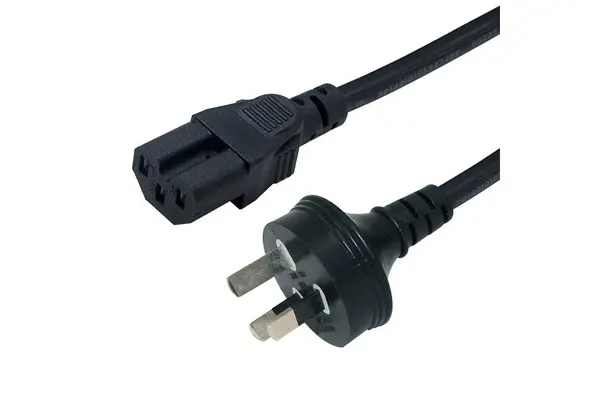
What Exactly Is an AS/NZS 3112 to IEC C15 High-Temp Cord?
Plug Standards and Structural Differences You Must Recognize
This is the AS/NZS 3112 plug, which is the standard three-pin plug in Australia and New Zealand. It can handle 10A/250V. It has three flat, angled pins. Two of them carry electricity, and the third one connects to earth. Australian electrical laws say that the live and neutral pins must have covers that protect them for safety reasons.
The IEC 60320 C15 connection, on the other hand, is made to work with cold-air equipment. What makes this connection plate special is a small notch on the bottom of it. This notch makes it impossible for a regular C13 connector to accidentally fit into the inlet of a high-temperature appliance. The C15 can work nonstop at temperatures up to 120°C, but the C13 can only do so at 70°C.
An AS/NZS 3112 to IEC C15 high-temp cord is suitable for applications that require an Australian or New Zealand mains plug paired with a heat-resistant IEC connector. Equipment such as server racks, autoclaves, industrial heaters, and commercial cooking appliances may require this type of power connection, depending on their electrical specifications and operating temperatures. When selecting an AS/NZS 3112 to IEC C15 high-temp cord, buyers should understand the differences between IEC C13 and IEC C15 connectors: C13 connectors are commonly used for standard IT equipment, while C15 connectors are designed for applications requiring higher-temperature tolerance, typically up to 120°C at the connector interface under specified conditions. Both connector types are commonly rated at 10A in relevant configurations, but the complete cord's rating must be verified separately. An AS/NZS 3112 to IEC C15 high-temp cord typically uses a C16 appliance inlet, whereas a C13 cord generally mates with a C14 inlet; C15 connectors may also physically fit compatible C14 inlets, but this does not make every combination suitable for high-temperature use. Before purchasing an AS/NZS 3112 to IEC C15 high-temp cord, procurement teams should confirm the plug standard, connector temperature rating, current capacity, cable specifications, and applicable certifications. These checks help ensure the selected AS/NZS 3112 to IEC C15 high-temp cord matches the equipment's operating requirements and intended installation environment.
| Feature | IEC C13 | IEC C15 |
|---|---|---|
| Max Temperature Rating | 70°C | 120°C |
| Physical Notch | No | Yes (safety keying) |
| Typical Application | Computers, monitors | Servers, kettles, high-heat equipment |
| Current Rating | 10A | 10A |
| Mating Inlet | C14 | C16 (also fits C14) |
What Are the Critical Selection Factors for High-Temperature Cords?
Insulation Material Performance Under Sustained Heat
Where it's hot, the fleece jacket is where most cord problems begin. Different things happen when heat-resistant PVC and rubber-based jackets, like those used in H05VV-F and H05RR-F wire constructions, are heated for a long time. There are places where wires move around a lot that are better for rubber (H05RR-F). This is because it doesn't crack as easily when it gets hot. PVC of a high grade is good for structures that don't need to be exposed to chemicals or UV light.
It doesn't matter what wire size you use. In general, a 1.0 mm² conductor can handle rack loads. On the other hand, a 1.5mm² conductor is better for things like autoclaves and industrial warming units that need to draw power all the time. If you pick conductors that are too small, the resistance goes up, the heat inside rises, and the insulation breaks down faster, which is more likely to happen in hot places.
Here are some things you should look into about the core material and specs before you buy:
- Temperature rating verification: Confirm the cord is rated for 105°C or 120°C depending on your equipment's operating environment. Using a 70°C-rated C13 cord in a C16 inlet is a safety violation and a fire hazard.
- Conductor material: Pure copper conductors maintain consistent conductivity across thermal cycles. CCA (copper-clad aluminum) alternatives carry higher resistance and are unsuitable for sustained high-current loads.
- Jacket integrity: Look for UL 94 V-0 or equivalent flame-retardant ratings on the outer jacket material. RoHS and REACH compliance confirms the absence of restricted hazardous substances.
These all have an effect on how well the cord works and whether it stops working after a few months of use.
How Do You Evaluate Suppliers Before Committing to a Bulk Order?
Certifications, Testing Evidence, and Supply Chain Transparency
Entering the Australian and New Zealand markets with an AS/NZS 3112 to IEC C15 high-temp cord requires careful attention to the applicable electrical safety and conformity requirements. Buyers should verify that the Australian mains plug complies with the relevant AS/NZS 3112 requirements and that the IEC C15 connector and complete cord assembly meet the applicable IEC 60320 specifications. When sourcing an AS/NZS 3112 to IEC C15 high-temp cord, procurement teams should also check the supplier's conformity documentation and determine whether the Regulatory Compliance Mark (RCM) and any relevant certification or approval requirements apply to the product. These requirements should not be assumed to be satisfied simply because a supplier displays a particular mark. Instead of relying solely on certificate or licence numbers, buyers should request supporting test reports, verify their validity, and confirm that they cover the exact model being purchased. For an AS/NZS 3112 to IEC C15 high-temp cord, documentation should address relevant electrical safety, connector compatibility, current rating, and temperature performance. By reviewing these records before placing a bulk order, businesses can reduce compliance risks and make more informed sourcing decisions. A transparent verification process helps ensure that each AS/NZS 3112 to IEC C15 high-temp cord is suitable for its intended application and the requirements of the destination market.
Not just the paperwork, but also look at how the supplier checks quality at the unit level. High-pot dielectric resistance testing, polarity and continuity checks, pull-force tests on strain relief, and thermal aging checks are all done on every lot of products made by reputable companies. If a provider can't explain their in-line QC process, they can't promise that big orders will be the same.
When buying something from a business-to-business (B2B), wait time and the ability to handle transportation are just as important as the product itself. It takes between 15 and 25 business days for well-known manufacturers to ship in bulk, but this depends on how big the order is. They should not say they can make fully certified cords in any length you want in less than 10 days. Most of the time, when lead times are short, pre-certified stock is renamed instead of custom-built goods.
What Should Your Procurement Process Look Like?
Balancing Custom Specifications Against Delivery Timelines
Power lines for factories and data centers that can handle high temperatures don't always come in a single package. People often ask for custom lengths, color-coded jackets to make it easier to find circuits, and private-label packaging, and a good manufacturer should be able to quickly meet these needs.
You should also check quotes from different sellers, not just the unit cost. See if the quote has these things:
- Traceability documentation for each production batch, including material certifications and test records — essential for regulated environments like hospitals and data centers.
- Minimum order flexibility: Established suppliers support small-batch replenishment without punitive MOQ requirements, allowing you to maintain lean inventory while preserving supply continuity.
- Post-purchase warranty: A one-year manufacturing defect warranty is an industry baseline. Suppliers offering less are offloading quality risk onto the buyer.
You can protect both your budget and the running of your business by buying things in an efficient way. If you make these terms clear from the start, you can avoid unpleasant and pricey shocks when the goods arrive.
How Should High-Temp Cords Be Installed and Maintained?
Inspection Protocols That Extend Service Life
Visual inspection is an essential first step when verifying an AS/NZS 3112 to IEC C15 high-temp cord for safe and compatible use. Before connecting the cord, buyers should confirm that the equipment has the appropriate IEC appliance inlet and that the connector matches the manufacturer's specifications. An IEC C15 connector is designed to mate with a compatible C16 inlet, which is intended for higher-temperature applications. Although a C15 connector may physically fit a C14 inlet in some configurations, physical compatibility alone does not establish that the combination is suitable for the equipment's operating temperature or electrical requirements. When inspecting an AS/NZS 3112 to IEC C15 high-temp cord, procurement teams should check the connector's identifying notch, rated temperature, current capacity, and relevant product documentation. The notch helps distinguish the C15 connector from a standard C13 connector, supporting correct identification during installation. For an AS/NZS 3112 to IEC C15 high-temp cord, buyers should also verify that the mains plug complies with the applicable AS/NZS 3112 requirements and that the complete assembly is rated for its intended application. These checks help prevent connector mismatches and ensure that each AS/NZS 3112 to IEC C15 high-temp cord is selected according to the equipment manufacturer's specifications.
A regular check should be done on the jacket to see if it has changed color, become stiffer, or cracked near the strain relief places. These are all early signs of damage from heat. There should be strain relief on both ends of the plug and socket. Make sure it is not loose or coming away from the case. If a cord shows these signs, it needs to be thrown away right away, even if it still seems to work electrically.
Also, maintenance teams should make sure that cords aren't run through places where the temperature is too high for them to handle. They should also make sure that the cables are bent in a way that doesn't damage the internal wires over time.
Conclusion
When sourcing an AS/NZS 3112 to IEC C15 high-temp cord, buyers should carefully evaluate connector compatibility, insulation materials, conductor quality, supplier credentials, and applicable compliance documentation. IEC C13 connectors are commonly used in applications with a connector temperature rating of 70°C, while IEC C15 connectors are designed for higher-temperature applications, typically with a 120°C connector rating under specified conditions. These connector types should not be treated as interchangeable for every application, because the equipment inlet and operating environment determine which configuration is appropriate. Before purchasing an AS/NZS 3112 to IEC C15 high-temp cord, procurement teams should verify the supplier's relevant approvals, check whether RCM requirements apply, and request batch-level test records covering the finished cord assembly. They should also confirm conductor size, insulation temperature rating, rated current, and the suitability of the cord for the intended equipment. A reliable supplier should provide clear technical documentation, consistent quality control, and responsive after-sales support. With the correct AS/NZS 3112 to IEC C15 high-temp cord, proper installation, and routine inspections, businesses can help maintain safe and dependable equipment operation over the long term. Verifying these details before ordering helps reduce sourcing risks and ensures that each AS/NZS 3112 to IEC C15 high-temp cord meets the application's technical requirements.

FAQ
What is the maximum operating temperature of a C15 cord?
We can use the IEC 60320 C15 connector all the time as long as the connection point stays at or above 120°C. This grade also applies to the jacket of the wire. H05VV-F and H05RR-F are the most popular types of wire that meet this need.
Can a C15 connector fit into a C14 inlet?
Without a doubt, physically. For the most part, the C15 plug can connect to a C14 outlet. But because the C15 has a real notch, you can't put a C13 into a C16 opening. Check the type of device inlet every time you want to change connection types.
How do I verify that a supplier's SAA certification is legitimate?
Ask for the full certification document. It should have the name of the certification group, the certificate number, and a list of the exact types of products that are protected. If you need to, you can compare this to the SAA or RCM public records. Suppliers you can trust will be happy to give you this paperwork.
What wire gauge should I specify for server rack applications?
1.0 mm wires are fine for standard 10A server rack loads. If your equipment consistently uses power close to the suggested limit or if you are concerned about voltage drop along longer cords, you should upgrade to 1.5mm².
Partner With Kuncan Electronics for Certified High-Temp Power Solutions
Kuncan Electronics is a trusted B2B company that has been in this business for 17 years and has high-temperature lines that are cleared by SAA/RCM and made to meet the needs of AS NZS 3112 to IEC C15. We can make jackets in different colors, jackets with your own name, and jackets of any length you want. It takes 15–25 days for bulk orders to arrive. There are 100% electrical tests and high-pot tests on every unit. Our AS/NZS 3112 to IEC C15 High-Temp Cord service team can be reached at rhea@szkuncan.net to get a price quote or to talk about your needs.
References
1. Standards Australia. AS/NZS 3112: Approval and Test Specification — Plugs and Socket-Outlets. Standards Australia, 2017.
2. International Electrotechnical Commission. IEC 60320-1: Appliance Couplers for Household and Similar General Purposes. IEC, 2021.
3. Energy Safe Victoria. Electrical Safety for Electrical Equipment — Compliance and Market Surveillance. Energy Safe Victoria, 2022.
4. Electrical Regulatory Authorities Council (ERAC). Regulatory Compliance Mark (RCM) Guidelines for Electrical Equipment. ERAC, 2020.
5. International Electrotechnical Commission. IEC 60227: Polyvinyl Chloride Insulated Cables of Rated Voltages Up to and Including 450/750V. IEC, 2007.
6. Standards Australia. AS/NZS 3000: Wiring Rules — Electrical Installations. Standards Australia, 2018.

USER EVALUATE
Here is the customer's evaluation of us